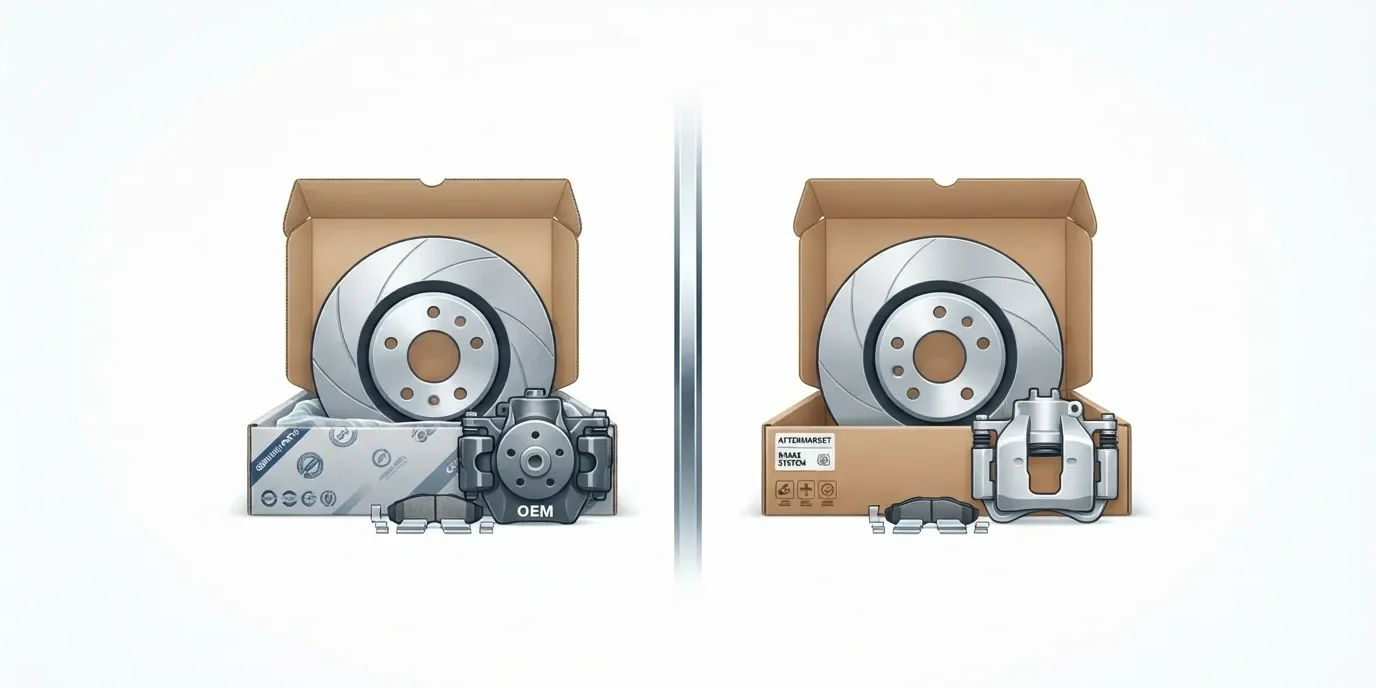
When your car needs a repair, the parts quotation can make a big difference to your decision. One workshop may recommend an original part, while another offers a cheaper aftermarket alternative. The price difference can look attractive, especially when several components need replacing at the same time.
But is choosing the cheaper part always the smarter decision? Understanding OEM vs aftermarket car parts can help you avoid unnecessary expenses, poor-quality replacements, repeat repairs, and unexpected problems down the road.
In this guide, we explain how both types of parts work, where each makes sense, and how Dubai drivers can choose the right replacement without paying more than necessary.
What Is the Difference Between OEM and Aftermarket Car Parts?
Understanding the difference starts with knowing who makes the part, what standards it follows, and how it is designed to fit your vehicle.
What are OEM car parts?
OEM stands for Original Equipment Manufacturer. OEM replacement parts are supplied through the vehicle manufacturer’s parts network and are designed to meet the required specifications for your vehicle.
They are commonly used when owners want a predictable replacement, correct fitment, and confidence in the component’s compatibility. OEM parts are often recommended for newer vehicles, complex electronic systems, and repairs where the correct specification is especially important.
What are aftermarket car parts?
Aftermarket parts are produced by independent companies rather than supplied through the vehicle manufacturer’s original parts network. They are designed to replace factory components, but their materials, manufacturing quality, design, and performance can vary between brands.
Some aftermarket manufacturers have strong reputations and produce reliable components. Others focus mainly on keeping prices low, which can affect durability or fitment.
The important point is that aftermarket does not automatically mean bad quality, just as OEM does not automatically mean the best choice for every repair.
OEM vs Aftermarket Car Parts: Key Differences
| Factor | OEM Parts | Aftermarket Parts |
|---|---|---|
| Manufacturer | Supplied through vehicle manufacturer network | Produced by independent brands |
| Price | Usually higher | Often more affordable |
| Fitment | Designed for vehicle specifications | Varies by manufacturer and application |
| Quality | Consistent specifications | Can range from excellent to poor |
| Availability | May require dealer ordering | Often available from multiple suppliers |
| Warranty | Depends on manufacturer and supplier | Depends on brand and seller |
| Choice | Usually limited options | Wide range of brands and options |
| Best suited for | Precision, complex, or specification-sensitive repairs | Budget-conscious and routine repairs when quality is verified |
The price difference is only one part of the decision. The quality of the component, its expected lifespan, installation requirements, and the consequences of failure matter just as much.
Why Cheaper Car Parts Can Cost You More in the Long Run
A lower parts price is not necessarily a lower repair cost. The real cost includes the component, installation, vehicle downtime, and the possibility of needing the same repair again.
For example, imagine your car needs a replacement water pump. You are offered two options, one from a reputable supplier and another from an unknown brand at a significantly lower price.
The cheaper pump may seem like a good deal. However, if its bearings wear out early, the seal begins leaking, or the component fails to perform correctly, you may need to pay for the replacement part and the labour all over again.
This is where a small saving can become a much larger expense. Some components are relatively simple to replace, while others require considerable labour to access. A part that fails shortly after installation can turn an affordable repair into a costly repeat job.
The hidden costs of low-quality parts
- Repeat labour costs: You may have to pay the workshop again to remove and replace the failed component.
- Additional damage: A failing part can affect connected components or cause another mechanical problem.
- Vehicle downtime: Repeated repairs mean more time without your car.
- Poor performance: Incorrect specifications can cause noise, vibration, leaks, warning lights, or reduced efficiency.
- Uncertain warranty coverage: Cheap parts may come with limited protection or unclear replacement terms.
In Dubai, where many drivers depend on their vehicles for daily commuting, these problems can become particularly frustrating. A repair that fails during a busy workweek or a long drive is not just inconvenient. It can disrupt your entire schedule.
Are Aftermarket Car Parts Always Lower Quality?
No. Some aftermarket car parts are excellent quality and can provide dependable performance for years. Certain manufacturers also supply components to vehicle makers and sell replacement parts under their own brand names.
A quality aftermarket part may offer the same function, similar materials, and reliable performance as the original replacement. Some aftermarket products are even designed to improve specific weaknesses or provide different performance characteristics.
The problem is that the aftermarket market includes many different manufacturers. Two parts designed for the same vehicle can have very different prices, construction quality, warranties, and expected service life.
Before approving an aftermarket replacement, ask your mechanic:
- Which brand is supplying the part?
- Is it a reputable manufacturer with a track record?
- Does it meet the correct specifications for my car?
- Is the part covered by a warranty?
- Is it suitable for Dubai’s heat and driving conditions?
- Would you personally recommend this part for my vehicle?
A workshop that can clearly explain why it recommends a particular part is usually a better sign than one that only focuses on the cheapest quotation.
Which Car Parts Should You Choose OEM For?
Not every component needs to be purchased from the dealership. However, some repairs require greater attention to specifications, compatibility, and safety.
1. Engine and timing components
Timing belts, timing chain components, tensioners, engine sensors, and critical engine parts must work within precise tolerances. A poorly made component may affect engine performance or lead to serious damage if it fails.
When dealing with expensive engine repairs, choosing a reliable OEM part or a proven original equipment supplier can be worth the extra cost.
2. Electronic and sensor components
Modern vehicles rely on electronic modules, sensors, wiring, and control systems. A replacement sensor with incorrect specifications may trigger warning lights, provide inaccurate readings, or fail to communicate properly with the vehicle.
For complicated electronic systems, OEM or high-quality supplier-branded components are often the safer choice.
3. Braking and suspension components
Brake pads, discs, control arms, ball joints, and suspension components directly affect vehicle handling and safety. Quality should never be compromised simply to reduce the parts bill.
A trusted aftermarket brand may be perfectly suitable, but the mechanic should verify fitment, specifications, and compatibility before installation.
4. Collision repair and body parts
Bumpers, structural components, mounting brackets, and body panels need correct fitment. Poorly fitting replacement panels may leave uneven gaps, create alignment problems, or require extra adjustment during installation.
For accident repairs, the quality and compatibility of the part should be considered alongside the price.
When Aftermarket Parts Are a Smart Choice
Choosing aftermarket parts can be a sensible way to control maintenance costs when the manufacturer and part quality are carefully selected.
Aftermarket replacements can be a good option for:
- Oil filters and air filters from reputable brands
- Spark plugs with the correct specifications
- Certain brake pad options suited to your driving style
- Common maintenance components for older vehicles
- Non-critical replacement components where quality and compatibility are verified
For example, if your car needs an air filter replacement, you may not need to spend extra on a dealership-branded component if a trusted manufacturer offers a suitable replacement that meets the required specifications.
The same applies to many routine maintenance items. A quality replacement can deliver good performance without unnecessary spending.
The goal is not to buy the most expensive part. It is to choose a component that does the job properly, lasts as expected, and provides value over its lifetime.
How Dubai’s Driving Conditions Affect Your Choice of Car Parts
Dubai’s climate and driving conditions can put extra stress on vehicle components. High temperatures, heavy traffic, frequent stop and go driving, long highway journeys, and dust can all affect how certain parts perform over time.
This makes part selection particularly important for components exposed to heat, friction, vibration, or constant use.
For example, a vehicle driven daily between Al Quoz, Business Bay, and Dubai Marina may spend considerable time in traffic. Brake components, cooling system parts, engine oil, belts, and filters need to remain in good condition to support reliable performance.
When choosing replacement parts, consider the following:
- Heat resistance: Rubber seals, hoses, belts, and plastic components need to withstand high temperatures.
- Dust protection: Air filters must provide proper filtration to protect the engine.
- Driving conditions: Frequent traffic and short trips may increase wear on certain components.
- Part compatibility: The replacement must match the vehicle’s engine, model year, trim, and specifications.
A part that performs well in one vehicle or driving environment may not be the ideal choice for another. This is why a mechanic should assess the vehicle and recommend a replacement based on its actual needs.
How to Choose the Right Replacement Part Without Overpaying
You do not need to become an automotive parts expert to make a smart repair decision. A few simple checks can help you understand the quotation and avoid paying for a component that is either unsuitable or unnecessarily expensive.
Step 1: Ask for both OEM and aftermarket options
If the workshop offers only one option, ask whether a suitable alternative is available. Comparing both prices helps you understand whether the difference is meaningful.
Step 2: Compare brands, not just prices
A low-priced part from an unknown supplier is not the same as a reasonably priced component from an established manufacturer. Ask for the brand name and product details before approving the repair.
Step 3: Confirm compatibility
Parts should be selected using the correct vehicle information. Depending on the component, the mechanic may need your VIN, engine code, model year, or specific part number.
Step 4: Ask about the warranty
Find out what warranty is offered on the part and whether it covers replacement in case of a defect. Also clarify whether labour for removing and reinstalling a failed part is included.
Step 5: Consider the total repair cost
Look beyond the price of the part. Consider installation labour, expected lifespan, warranty, availability, and the risk of repeat repairs.
A good repair decision should balance affordability, quality, and long-term reliability. Paying slightly more for a component that lasts longer may be a better investment than repeatedly replacing cheaper parts.
Why Your Mechanic’s Recommendation Matters
Parts selection is not just about reading product labels or comparing online prices. A mechanic who understands your vehicle can identify the correct specifications, recognise common failure patterns, and recommend components suited to your repair.
An experienced technician may also know which aftermarket brands perform reliably for a particular model and which components are better replaced with OEM parts.
For instance, replacing a worn suspension arm may offer several aftermarket choices. However, if your vehicle has a complicated electronic suspension system, selecting the wrong component could lead to fitment issues, warning messages, or further diagnostic work.
At Car Garage Auto Services, the focus should be on helping drivers understand what their vehicle needs before committing to a repair. Comparing suitable part options, explaining the difference in cost and quality, and checking the component against the vehicle’s specifications helps customers make informed decisions.
The right repair is not simply the one with the lowest quotation. It is the one that addresses the problem properly and offers lasting value.
OEM vs Aftermarket Car Parts: Which One Should You Choose?
There is no single answer for every vehicle. The best choice depends on the component, your car’s age, driving conditions, budget, warranty requirements, and how long you plan to keep the vehicle.
| Your situation | Recommended approach |
|---|---|
| New car under warranty | Check manufacturer warranty requirements and use approved parts where needed |
| Luxury or performance vehicle | Consider OEM or proven supplier-quality components |
| Older vehicle | Quality aftermarket parts can offer excellent value |
| Safety-related repair | Prioritise proven quality, fitment, and correct specifications |
| Routine maintenance | Compare OEM with reputable aftermarket brands |
| Expensive labour-intensive repair | Consider durability and warranty before choosing the cheapest part |
If you are unsure, ask your mechanic to explain the differences between the options available for your particular vehicle. A transparent comparison can help you avoid both unnecessary spending and risky compromises.
Frequently Asked Questions
Are OEM car parts better than aftermarket parts?
OEM parts offer predictable specifications and compatibility with the vehicle. However, reputable aftermarket manufacturers can produce equally reliable components. The better option depends on the part, manufacturer, quality standards, and your vehicle’s requirements.
Are aftermarket car parts safe to use?
Yes, aftermarket parts can be safe when they come from reputable manufacturers and meet the correct specifications. Safety-critical parts such as brakes, steering, and suspension should never be selected based on price alone.
Why are OEM parts more expensive?
OEM parts may cost more because of manufacturer branding, supply channels, distribution, warranty support, and vehicle-specific requirements. However, a higher price does not automatically mean a part will last longer than a quality aftermarket alternative.
Can aftermarket parts damage my car?
Poor-quality or incompatible aftermarket parts can cause problems such as leaks, excessive noise, premature wear, electrical faults, or incorrect fitment. Choosing a reliable brand and confirming compatibility before installation can reduce these risks.
Should I use OEM parts for my luxury car in Dubai?
For luxury vehicles, OEM or trusted original equipment supplier parts are often worth considering, especially for engine components, electronics, suspension systems, and safety-related repairs. However, some aftermarket brands offer excellent replacements for routine maintenance.
How can I know if my mechanic is using quality replacement parts?
Ask for the part’s brand, part number, warranty details, and whether it is OEM, supplier-branded, or aftermarket. A reliable workshop should be comfortable explaining what is being installed and why it is suitable for your car.
Final Thoughts
Choosing between OEM vs aftermarket car parts is not simply about paying more or less. It is about understanding what your vehicle needs and selecting a component that offers the right balance of quality, compatibility, durability, and cost.
A cheaper part can be a smart purchase when it comes from a reliable manufacturer. On the other hand, cutting corners on critical components can lead to repeat repairs, additional labour, and unnecessary stress.
If your vehicle needs maintenance or replacement parts in Dubai, Car Garage Auto Services can help you understand your options, assess the repair requirements, and choose parts suited to your vehicle. Making the right decision today can save you money, time, and trouble on the road tomorrow.
Choose the right part. Repair it properly. Drive with confidence.