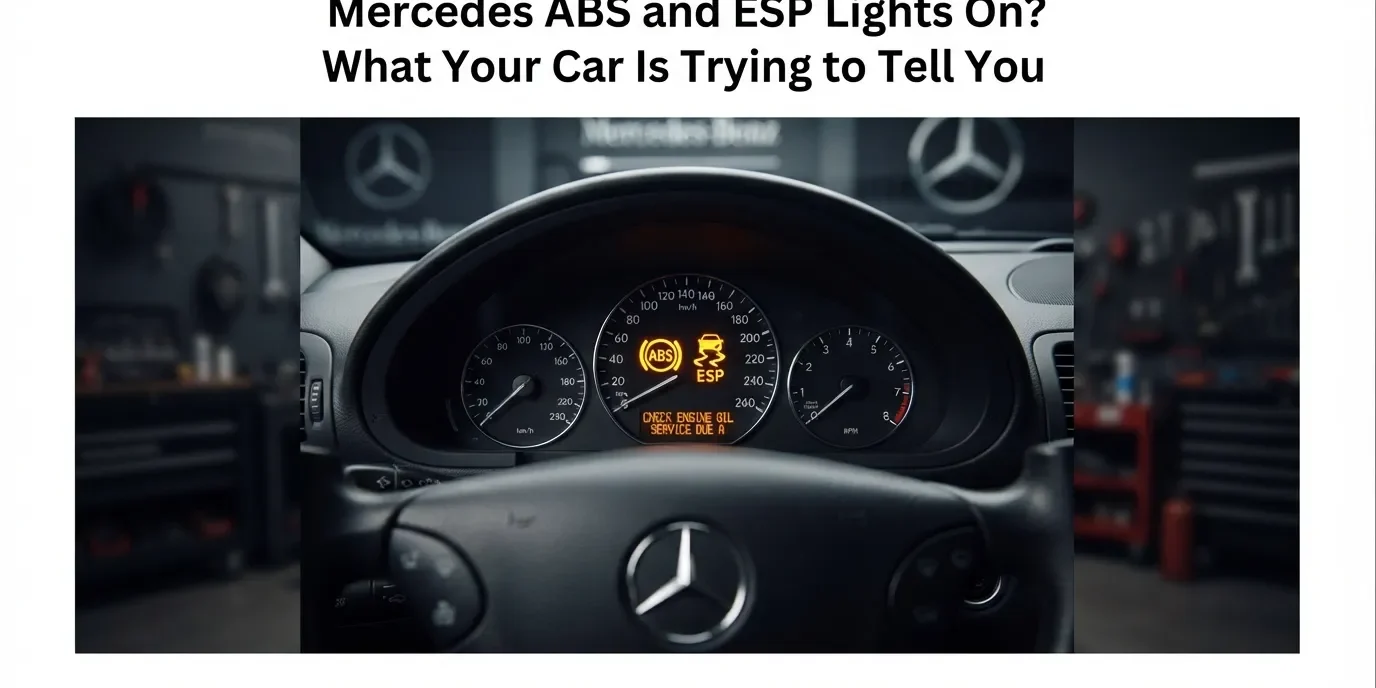
When the ABS and ESP warning lights appear on your Mercedes dashboard, it is easy to assume that something is wrong with the brakes. Sometimes the issue is related to a wheel speed sensor, but in other cases, the problem may involve the battery, steering angle sensor, wiring, or the ABS control system.
These warning lights should not be ignored, especially when driving through Dubai traffic or at higher speeds. Your Mercedes is designed to help you maintain control during sudden braking and slippery conditions, and these systems play an important role in that process.
If you have Mercedes ABS and ESP lights on, understanding what triggers them, how they affect your driving, and when you need professional diagnostics can help you avoid unnecessary repairs and reduce safety risks.
What Do ABS and ESP Do in a Mercedes-Benz?
Before looking at possible faults, it helps to understand why your Mercedes has these systems and why both warning lights may appear at the same time.
What is ABS?
ABS stands for Anti-lock Braking System. It prevents your wheels from locking when you apply heavy braking. This helps you maintain steering control while slowing down, particularly during emergency braking or when the road surface has limited grip.
Without properly functioning ABS, your wheels may lock during hard braking. This can make it more difficult to steer around an obstacle and may increase your stopping distance in certain conditions.
What is ESP?
ESP stands for Electronic Stability Program. It helps keep your Mercedes stable when the car begins to lose grip or move away from the direction you are steering.
The system uses information from wheel speed sensors, steering inputs, and other vehicle sensors to detect instability. If it senses a possible skid, it can apply braking to individual wheels and reduce engine power to help bring the vehicle back under control.
When ABS or ESP develops a fault, your Mercedes may disable related safety functions. This is why both lights can appear together, even when the car seems to drive normally. Mercedes-Benz+1
Why Are the Mercedes ABS and ESP Lights On Together?
When both warning lights stay illuminated while the engine is running, it usually means the vehicle has detected a fault in one or more systems responsible for braking assistance or stability control.
The ABS and ESP systems share sensor information. A fault affecting one important input may cause the car to disable both systems to prevent incorrect operation.
The problem may be relatively simple, such as a damaged sensor or weak battery, but it can also involve electronic components that need advanced testing.
Here are some of the most common causes.
1. Faulty Wheel Speed Sensor
A wheel speed sensor is one of the first components a mechanic checks when Mercedes ABS and ESP lights appear together.
Each wheel has a sensor that measures how quickly it rotates. The ABS control unit uses this information to identify when a wheel is slowing down too quickly or losing grip.
If one sensor stops sending accurate information, the system may no longer be able to compare wheel speeds correctly.
Common signs include:
- ABS and ESP warning lights appearing together.
- Traction control becoming unavailable.
- Cruise control stopping or refusing to activate.
- Warning lights appearing after driving for a short distance.
A damaged sensor, wiring problem, contamination, or an issue with the magnetic encoder ring can cause similar symptoms. Replacing a sensor without confirming the fault may lead to unnecessary spending.
2. Weak Battery or Low Voltage
Mercedes vehicles rely on electronic control modules that need stable electrical power. A weak battery or charging system problem can cause warning lights to appear, particularly during startup.
You may notice the ABS and ESP lights after the car has been sitting overnight, after a difficult start, or when several electrical warnings appear together.
Dubai’s heat can also put extra stress on vehicle batteries. If your battery is old, it is worth checking its condition and the alternator’s charging output before replacing expensive ABS components.
3. Steering Angle Sensor Problem
The steering angle sensor tells the vehicle how far and in which direction the steering wheel is turned.
ESP uses this information to compare the driver’s intended direction with the vehicle’s actual movement. If the sensor provides incorrect information or loses calibration, the stability system may not work as expected.
This issue can appear after:
- Wheel alignment.
- Steering rack repairs.
- Battery disconnection.
- Suspension repairs.
- Steering angle sensor replacement.
In some cases, calibration may solve the issue. If the sensor itself is faulty, further testing and repair may be necessary.
4. Brake Light Switch Malfunction
The brake light switch is a small component, but it plays an important role in communication between your brake pedal and the vehicle’s electronic systems.
If the switch sends incorrect signals, your Mercedes may not correctly recognise when the brakes are applied. Depending on the model, this can trigger ABS, ESP, BAS, or other warning messages.
Sometimes the brake lights may also behave unusually, staying on or failing to illuminate correctly. A diagnostic scan can help identify whether the switch is causing the problem.
5. ABS Control Module or Hydraulic Unit Failure
If the sensors, wiring, battery, and brake switch are working properly, the ABS control module or hydraulic unit may be responsible.
These components manage brake pressure and coordinate ABS operation. Internal electronic faults, communication problems, pump issues, or damaged connections can cause the system to stop functioning.
This type of repair requires proper diagnosis. Replacing an ABS module based only on dashboard warning lights is not a good idea because several other faults can produce similar symptoms.
6. Damaged Wiring or Connector Problems
Dubai roads, heat, moisture, previous repairs, and vibration can affect electrical connections around the wheel hubs and suspension.
A sensor may be perfectly healthy but unable to send a reliable signal because its wiring is damaged or its connector is loose.
This is why a proper Mercedes ABS diagnosis should include checking the electrical circuit, not just reading the fault code and replacing the component mentioned in the scan.
Can You Drive a Mercedes With ABS and ESP Lights On?
You may still have normal braking, but driving with ABS and ESP warning lights on is not considered safe to ignore. Your conventional braking system may continue to operate, but ABS assistance and electronic stability control may be unavailable. Your wheels could lock during heavy braking, and the car may be harder to control during sudden manoeuvres.
If the warning lights appear while driving, reduce your speed, leave more distance between your car and other vehicles, and avoid aggressive braking or sharp steering.
If you also notice a soft brake pedal, a hard brake pedal, brake fluid loss, a red brake warning light, unusual noises, or reduced braking performance, stop in a safe location and arrange professional assistance.
Mercedes owner manuals advise careful driving and prompt inspection when ABS malfunctions because braking and steering performance may be affected. Mercedes-Benz+1
What Should You Do When the Warning Lights Appear?
Do not panic if the lights suddenly come on, but do not keep driving as if nothing has happened. A few simple observations can help you explain the issue to your mechanic.
- Check whether the warning lights remain on after restarting the car.
- Notice if the problem appears immediately or after driving for a few minutes.
- Check whether other warning messages appear on the dashboard.
- Pay attention to unusual brake pedal behaviour.
- Avoid testing the ABS yourself with sudden braking on public roads.
If the lights disappear after restarting, the fault may still be stored in the vehicle’s control module. An intermittent warning does not automatically mean the issue has been fixed.
The best next step is to have the vehicle scanned using diagnostic equipment that can communicate with the Mercedes ABS and ESP control modules.
How a Mercedes ABS and ESP Fault Is Diagnosed
A proper diagnosis should identify the actual cause of the warning lights rather than simply clear them from the dashboard.
At a professional workshop, the process usually involves several steps.
Step 1. Scan the ABS and ESP Modules
The mechanic checks stored and current fault codes using Mercedes-compatible diagnostic equipment. This helps identify whether the system is reporting a wheel speed signal, voltage problem, communication fault, sensor issue, or internal module error.
Step 2. Check Live Sensor Data
Live data can help compare the speed readings of all four wheels. If one wheel reports zero speed while the others are moving, or its reading becomes inconsistent, that can help narrow down the issue.
Step 3. Inspect Sensors and Wiring
The technician checks the relevant wheel speed sensor, wiring harness, connectors, and encoder ring for damage, contamination, or loose connections.
Step 4. Test the Battery and Charging System
Battery condition and charging voltage are checked to rule out electrical instability that could affect the ABS control module.
Step 5. Repair and Confirm the Fault Is Resolved
After the repair, fault codes are cleared where appropriate, the system is checked again, and the vehicle is tested to confirm that the warning lights do not return.
This diagnostic approach helps prevent unnecessary parts replacement and gives the owner a clearer idea of what the repair actually involves.
Mercedes ABS and ESP Repair in Dubai
Driving in Dubai means dealing with busy roads, frequent stop and go traffic, high temperatures, and occasional sudden braking situations. Your Mercedes’ braking and stability systems need to work properly in these conditions.
If your Mercedes ABS and ESP lights are on, a proper inspection can help identify whether the problem is related to a wheel speed sensor, electrical supply, steering angle calibration, brake switch, or ABS control unit.
At Car Garage Auto Services in Dubai, Mercedes diagnostic and repair services can help identify the source of ABS and ESP warning lights before unnecessary components are replaced. The goal is to understand the fault, explain the repair options, and restore the vehicle’s safety systems as far as the confirmed fault allows.
If your Mercedes is showing an ABS malfunction, ESP inoperative message, or multiple brake system warnings, arranging a diagnostic check is a sensible next step.
How Much Does Mercedes ABS and ESP Repair Cost in Dubai?
The repair cost depends on the component responsible for the fault and the Mercedes model you drive.
A sensor replacement or wiring repair may cost less than repairing an ABS hydraulic unit or replacing a control module. Some problems only require calibration, while others need replacement parts and additional programming.
| Fault | Possible repair |
|---|---|
| Wheel speed sensor fault | Sensor replacement or circuit repair |
| Low battery voltage | Battery replacement or charging system repair |
| Steering angle sensor issue | Calibration or sensor replacement |
| Brake light switch fault | Switch replacement |
| Wiring or connector damage | Electrical repair |
| ABS control module fault | Module repair or replacement, depending on testing |
A diagnostic check before repair is important because the same ABS and ESP warning lights can have several different causes. A confirmed diagnosis is more useful than guessing which part needs replacement.
How to Prevent ABS and ESP Problems in Your Mercedes
ABS and ESP faults cannot always be prevented, but regular maintenance can help reduce the risk of electrical and sensor related problems.
Keep your Mercedes battery in good condition, especially if your car takes longer to start or displays multiple warning messages. Make sure wheel alignment and suspension repairs are carried out correctly, and do not ignore warning lights that appear after tyre, brake, or steering work.
If you notice a warning that comes and goes, get it checked early. Small electrical or sensor problems can become more complicated if they are left unresolved.
Conclusion
When your Mercedes ABS and ESP lights come on together, the car is warning you that important braking or stability assistance may not be available. The problem could be a faulty wheel speed sensor, weak battery, steering angle sensor, damaged wiring, brake switch, or ABS control module.
Your normal brakes may still work, but your vehicle may not provide the same level of control during emergency braking or slippery conditions.
Instead of ignoring the warning or replacing parts without testing, arrange a professional Mercedes diagnostic inspection. If you are experiencing ABS or ESP problems in Dubai, Car Garage Auto Services can help identify the fault and recommend the right repair for your vehicle.
Taking action early can help protect your Mercedes, improve driving safety, and prevent unnecessary repair expenses.
Frequently Asked Questions
Why are my Mercedes ABS and ESP lights on at the same time?
When both lights appear together, the car may have detected a fault affecting the ABS or stability control systems. Common causes include a faulty wheel speed sensor, low battery voltage, steering angle sensor problems, damaged wiring, or an ABS module fault.
Can I drive my Mercedes if the ABS light is on?
Your conventional brakes may still work, but ABS assistance may be unavailable. Your wheels can lock during hard braking, so drive cautiously and arrange a professional inspection as soon as possible. If braking performance changes or a red brake warning appears, stop safely and arrange assistance.
Can a weak battery cause ABS and ESP warning lights?
Yes. Low or unstable battery voltage can affect electronic control modules and trigger ABS or ESP warnings. Battery and charging system testing should be part of the diagnostic process before replacing expensive components.
Does a wheel speed sensor cause both ABS and ESP lights?
Yes. ABS and ESP use wheel speed information to monitor braking and vehicle stability. If one sensor provides an incorrect or missing signal, both systems may become unavailable.
How do I fix Mercedes ABS and ESP warning lights in Dubai?
The correct repair depends on the stored fault codes and diagnostic results. A workshop should scan the ABS and ESP modules, check sensor readings, inspect wiring, test battery voltage, and repair the confirmed fault before clearing the warning lights.