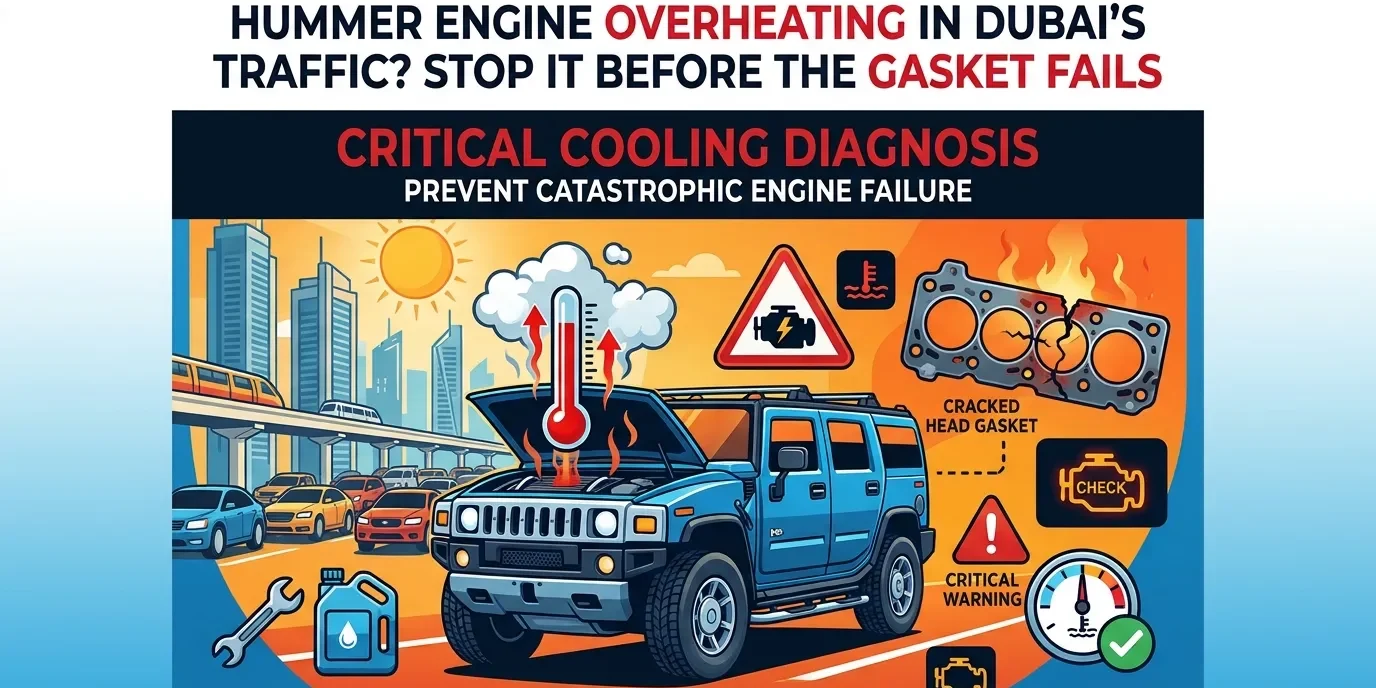
Imagine driving your Hummer H2 or H3 through Sheikh Zayed Road during rush hour. The air conditioning is running, traffic is barely moving, and suddenly the temperature gauge starts climbing. You might think it is just Dubai’s extreme heat, but an overheating engine is often a warning that something in the cooling system is failing. Hummer Engine Overheating in Dubai should never be ignored, especially when repeated overheating can damage the cylinder head and head gasket. In this guide, we explain the common causes, warning signs, repair options, and how to protect your Hummer before a minor cooling issue becomes a major engine repair.
Why Does a Hummer Engine Overheat in Dubai Traffic?
Hummer vehicles are built for strength, off-road performance, and demanding driving conditions. However, their large engines and heavy body design place considerable demands on the cooling system.
Dubai creates additional challenges. High outdoor temperatures, long traffic queues, frequent air conditioning use, and accumulated sand and dust can make it harder for the radiator to release engine heat.
When your Hummer moves at highway speed, natural airflow helps cool the radiator. During slow traffic, the cooling fan must do more of this work. If the fan clutch is weak, the radiator is blocked, or coolant circulation is poor, engine temperature can rise quickly.
This is why some Hummer owners notice overheating around Al Quoz, Business Bay, Deira, or Sheikh Zayed Road but experience fewer problems while driving at higher speeds.
The important thing is to identify the actual fault instead of assuming that the weather is responsible.
7 Common Causes of Hummer Engine Overheating in Dubai
Understanding what causes overheating can help you recognise problems before they damage expensive engine components.
1. Weak or Faulty Radiator Fan Clutch
The radiator fan plays an important role in controlling engine temperature, especially when your Hummer is stationary or moving slowly.
Many H2 and H3 models use a belt-driven cooling fan with a viscous fan clutch. This component controls how quickly the fan spins according to cooling requirements.
When the fan clutch becomes weak, the fan may not pull enough air through the radiator at low speeds. As a result, the engine temperature can rise while waiting at traffic signals or driving through congested roads.
Common warning signs include:
- Temperature rises while sitting in traffic.
- Engine temperature improves when driving faster.
- Cooling performance becomes inconsistent.
- The engine feels hotter when the AC is running.
A proper fan clutch inspection can help determine whether replacement is necessary.
2. Radiator Blockage From Sand and Dust
Dubai’s dusty environment can affect radiator performance over time. Sand, dirt, insects, and road debris can collect between the air conditioning condenser and radiator.
Even when the radiator looks clean from the front, debris trapped deeper inside can restrict airflow.
A blocked radiator cannot release heat efficiently. This becomes particularly noticeable when driving slowly with the air conditioning running.
Professional radiator cleaning should include an inspection of the cooling fins and the space between the radiator and condenser. High-pressure cleaning should be avoided because it can damage delicate radiator fins.
If internal corrosion or severe blockage is present, radiator replacement may be a better long-term solution.
3. Coolant Leaks From Hoses or Reservoir Tanks
Your Hummer’s cooling system needs the correct amount of coolant to maintain a stable operating temperature.
Over time, rubber hoses, plastic connections, radiator tanks, and coolant reservoirs can become weak. Repeated exposure to engine heat can cause small cracks that allow coolant to escape.
You might notice:
- A sweet smell around the engine bay.
- Coolant marks underneath the vehicle.
- A coolant level that keeps dropping.
- Steam coming from under the bonnet.
- An overheating warning after longer drives.
A coolant leak should never be treated as a normal maintenance issue. Repeatedly adding coolant without finding the leak only delays the real repair.
A cooling system pressure test can help identify leaks that may not be visible when the engine is cold.
4. Failing Water Pump
The water pump circulates coolant between the engine and radiator. If it cannot maintain proper coolant flow, engine temperature may increase.
A worn water pump can develop internal damage or leakage around its seals.
Some common symptoms include coolant leaking near the front of the engine, unusual noises around the belt area, and temperature fluctuations.
In some cases, a water pump problem may develop gradually. Drivers continue using the vehicle because the temperature warning appears only occasionally.
However, delaying inspection can increase the risk of overheating and further engine damage.
5. Stuck Thermostat
The thermostat controls when coolant flows through the radiator.
When the engine is cold, the thermostat restricts coolant flow to help the engine reach its operating temperature. Once the correct temperature is reached, it opens to allow coolant to circulate through the radiator.
If the thermostat becomes stuck closed, coolant cannot flow through the radiator as intended.
This can cause the engine to overheat even during relatively short journeys.
A faulty thermostat may also cause inconsistent temperature readings or unusual heating behaviour.
Replacing the thermostat can solve the problem when testing confirms that it is responsible.
6. Incorrect or Degraded Engine Coolant
Coolant does more than prevent the engine from overheating. It also protects internal cooling system components against corrosion and helps maintain suitable operating temperatures.
Using the wrong coolant specification, mixing incompatible coolant types, or continuing to use degraded fluid can affect cooling system performance.
For Hummer owners, it is important to follow the coolant specification recommended for the exact model and engine.
A professional coolant service should include:
- Checking the existing coolant condition.
- Inspecting for contamination.
- Checking for leaks.
- Flushing the system when required.
- Refilling with the correct coolant mixture.
- Removing trapped air from the cooling system.
Simply adding water or mixing different coolant products without checking compatibility is not a reliable repair.
7. Head Gasket Damage
The head gasket creates a seal between the engine block and cylinder head. It prevents coolant, engine oil, and combustion gases from mixing.
Severe or repeated overheating can damage this seal.
Once the head gasket fails, the problem becomes much more serious because coolant can enter the combustion chambers or mix with engine oil.
Possible warning signs include:
- Thick white exhaust smoke.
- Repeated coolant loss without an obvious external leak.
- Bubbles appearing in the coolant reservoir.
- Milky or contaminated engine oil.
- Persistent overheating.
- Rough engine operation.
These symptoms do not automatically confirm head gasket failure. A combustion leak test, cooling system pressure test, and other diagnostic checks are needed before approving major engine repairs.
How to Recognise Early Hummer Overheating Symptoms
A Hummer does not always develop a major cooling problem suddenly. In many cases, the first warning signs appear during everyday driving.
Pay attention if you notice any of the following:
| Warning sign | What it may indicate |
|---|---|
| Temperature gauge keeps rising | Cooling system fault |
| Overheating mainly in traffic | Fan or radiator airflow problem |
| Coolant level drops repeatedly | Coolant leak |
| Steam from the bonnet | Coolant escaping onto hot components |
| AC switches off during overheating | Engine protection response |
| White exhaust smoke | Possible internal coolant leakage |
| Coolant reservoir bubbles | Possible combustion gas leakage |
One important detail is the difference between overheating at idle and overheating at highway speed.
If your Hummer gets hot while stationary but cools down once you start moving, radiator airflow and fan performance deserve attention.
If it overheats at both low and high speeds, coolant circulation, thermostat operation, radiator condition, or internal engine problems may be involved.
These patterns help guide diagnosis, but they are not a replacement for proper testing.
What Should You Do When Your Hummer Overheats in Dubai?
If your temperature gauge moves into the red zone or an engine overheating warning appears, do not continue driving to reach your destination.
Follow these steps:
- Turn off the air conditioning: This can reduce additional cooling system load while you look for a safe place to stop.
- Move to a safe location: Avoid stopping in a dangerous traffic lane or on an unsafe road shoulder.
- Switch off the engine: Once safely parked, turn off the engine to prevent further heat buildup.
- Never open the coolant cap while hot: The cooling system is pressurised, and escaping coolant or steam can cause serious burns.
- Arrange professional assistance: If the engine has overheated, arrange recovery rather than risking further damage by driving.
Do not pour cold water over a hot engine or attempt roadside repairs around moving belts and fans.
If the temperature warning appears repeatedly, the vehicle needs a proper inspection even if the gauge returns to normal after cooling down.
How Do Mechanics Diagnose Hummer Cooling System Problems?
Replacing parts without identifying the actual fault can waste money and leave the overheating problem unresolved.
At Car Garage Auto Services, a structured diagnostic approach is important when investigating Hummer cooling problems in Dubai.
Depending on the symptoms, the inspection may include the following checks.
Computer Diagnostic Scan
A diagnostic scanner helps technicians check stored fault codes and monitor coolant temperature readings. This can also help identify possible sensor or electrical problems.
Cooling System Pressure Test
A pressure test checks whether the cooling system can maintain pressure. It can help reveal leaks from hoses, radiator connections, reservoirs, and other components.
Radiator and Fan Inspection
The radiator is checked for external blockage, damaged fins, internal restrictions, and signs of leakage. The cooling fan and fan clutch are also inspected for correct operation.
Thermostat and Water Pump Inspection
Technicians check coolant circulation and thermostat operation to identify possible restrictions or mechanical failures.
Head Gasket Testing
If symptoms suggest internal engine damage, additional tests such as a combustion gas test can help determine whether combustion gases are entering the cooling system.
The exact diagnostic procedure depends on the Hummer model, engine type, and symptoms.
Hummer Cooling System Repair Options in Dubai
Once the cause has been identified, the correct repair can be recommended.
The repair required depends on the condition of your cooling system and whether overheating has already affected other engine components.
| Identified problem | Possible repair |
|---|---|
| Weak fan clutch | Fan clutch replacement |
| Blocked radiator | Professional radiator cleaning or replacement |
| Coolant hose leakage | Hose and connection replacement |
| Faulty water pump | Water pump replacement |
| Stuck thermostat | Thermostat replacement |
| Degraded coolant | Cooling system flush and refill |
| Damaged head gasket | Engine inspection and head gasket repair |
Not every overheating problem requires major engine work. A faulty thermostat or leaking hose may be relatively straightforward to repair.
However, if the engine has repeatedly overheated, technicians should also inspect for cylinder head distortion, internal coolant leakage, and other related damage.
At Car Garage Auto Services, the goal should be to identify the failed component, explain the required repair, and help the owner understand the condition of the engine before work begins.
How Can You Prevent Hummer Engine Overheating in Dubai?
Preventive maintenance is especially important for older Hummer vehicles that have experienced several years of UAE driving conditions.
A few regular checks can reduce the risk of unexpected cooling system problems.
Check Coolant Levels Regularly
Inspect the coolant reservoir when the engine is completely cold. If the level keeps dropping, arrange an inspection instead of repeatedly topping it up.
Keep the Radiator Clean
Dust and debris can restrict airflow. Have the radiator and condenser area inspected and cleaned when necessary.
Inspect Hoses and Connections
Look for cracks, swelling, loose clamps, and signs of coolant leakage.
Follow the Correct Coolant Service Schedule
Use the coolant type and replacement interval recommended for your particular Hummer model.
Monitor Temperature During Traffic
Pay attention to unusual temperature changes, especially when driving with the AC running in slow traffic.
Investigate Small Problems Early
A minor coolant leak or weak fan clutch can become a much more expensive problem if ignored.
Why Choose Car Garage Auto Services for Hummer Engine Overheating in Dubai?
When a Hummer develops an overheating problem, choosing a workshop that understands engine cooling systems is important.
Car Garage Auto Services provides automotive maintenance and repair support in Dubai, including assistance with engine-related problems.
Whether your Hummer H2 or H3 is experiencing coolant loss, radiator issues, temperature fluctuations, or suspected head gasket damage, the first step is a proper diagnosis.
The right inspection can help you understand:
- Why your Hummer is overheating.
- Whether the radiator, fan, thermostat, or water pump needs attention.
- Whether coolant is leaking from the system.
- Whether overheating has affected the engine internally.
- Which repairs are necessary to restore reliable operation.
Instead of replacing several parts based on guesswork, start with an inspection that identifies the actual problem.
If your Hummer is overheating in Dubai traffic, Car Garage Auto Services can help you assess the cooling system and understand the next repair steps.
Conclusion: Don’t Let a Small Cooling Problem Damage Your Hummer Engine
Hummer engine overheating in Dubai can start with something as simple as a weak fan clutch, blocked radiator, coolant leak, or faulty thermostat. However, ignoring these warning signs can lead to cylinder head damage, head gasket failure, and expensive engine repairs.
The best approach is to identify the problem early, use the correct replacement parts, and maintain the cooling system according to your vehicle’s requirements.
If your Hummer’s temperature gauge keeps rising in traffic, do not wait for the engine warning to become a breakdown. Contact Car Garage Auto Services for a professional inspection and take care of the problem before it becomes more serious.
Frequently Asked Questions
1. Why does my Hummer overheat in Dubai traffic but not on the highway?
This often indicates a problem with radiator airflow or cooling fan performance. At highway speeds, natural airflow helps cool the radiator. In slow traffic, the fan must provide sufficient airflow. A weak fan clutch or blocked radiator can cause overheating at idle.
2. Can a faulty radiator fan cause Hummer engine overheating?
Yes. A faulty cooling fan or viscous fan clutch can reduce airflow through the radiator, particularly when the vehicle is stationary or moving slowly. This can cause engine temperature to rise during traffic conditions.
3. What are the signs of a blown Hummer head gasket?
Common warning signs include persistent coolant loss, thick white exhaust smoke, bubbles in the coolant reservoir, contaminated engine oil, and repeated overheating. Professional testing is necessary to confirm head gasket failure.
4. Is it safe to drive a Hummer when the temperature gauge is rising?
No, continuing to drive an overheating Hummer can cause serious engine damage. Stop safely, switch off the engine, and arrange professional assistance. Never open the coolant reservoir while the engine is hot.
5. How much does Hummer engine overheating repair cost in Dubai?
The cost depends on the failed component and the extent of the damage. A thermostat or hose replacement is generally less expensive than radiator or water pump replacement. Head gasket repairs can cost considerably more because they involve extensive engine work. A proper diagnosis is required before providing an accurate quotation.