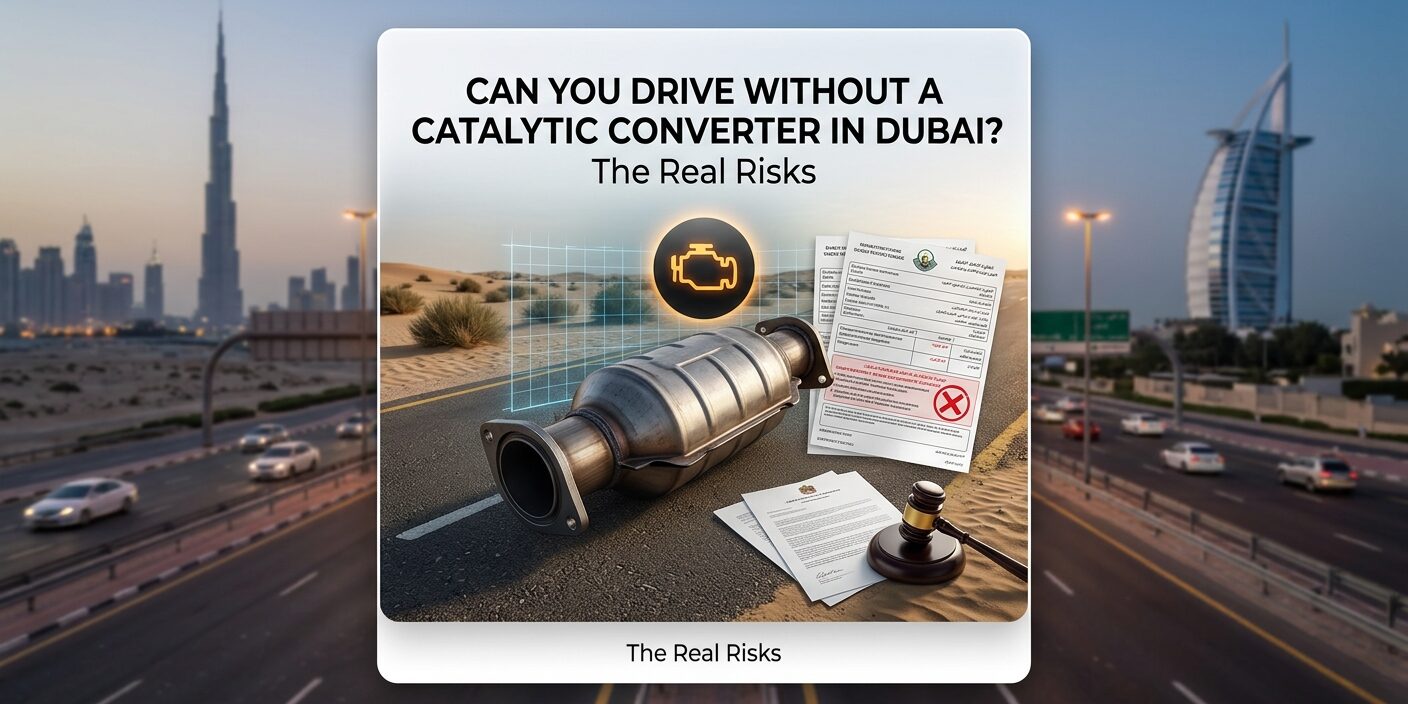
Imagine starting your car and hearing a much louder exhaust sound than usual. Perhaps your vehicle suddenly feels different, or a mechanic has suggested removing the catalytic converter to improve exhaust flow. While this might seem like a quick and affordable solution, it can create bigger problems later.
If you are wondering whether you can drive without a catalytic converter in Dubai, there are several things you should understand first. From vehicle emissions and engine performance to UAE road regulations and inspection requirements, this guide explains the real risks and why repairing the original exhaust system is usually the better choice.
What Is a Catalytic Converter and Why Does Your Car Need One?
A catalytic converter is an important part of your vehicle’s exhaust system. It is designed to reduce harmful gases produced when fuel burns inside the engine. It uses special metals inside a honeycomb structure to convert dangerous pollutants into less harmful emissions before they leave the exhaust pipe.
Most modern petrol vehicles are equipped with catalytic converters as part of their emission control systems. Without this component, your vehicle releases more harmful pollutants into the atmosphere.
A properly working catalytic converter helps your vehicle:
- Reduce harmful exhaust emissions.
- Control carbon monoxide and nitrogen oxide output.
- Reduce certain harmful hydrocarbons.
- Meet applicable vehicle emission requirements.
- Maintain the original exhaust system configuration.
In Dubai, where thousands of vehicles travel daily through busy roads, emission control is an important part of responsible vehicle ownership.
Can You Drive Without a Catalytic Converter in Dubai?
Technically, some petrol cars can still start and run after their catalytic converter has been removed. However, being mechanically capable of moving does not mean the vehicle is suitable or legally compliant for road use.
The UAE has vehicle technical requirements covering roadworthiness, approved specifications and pollution control. Federal Decree Law No. 14 of 2024 requires vehicles to be in good technical condition and comply with approved specifications. It also regulates substantial vehicle modifications, which require approval from the relevant licensing authority.
The UAE’s vehicle technical regulations also identify an anti-pollution system and muffler as required equipment.
Therefore, removing or bypassing the catalytic converter can put your vehicle’s compliance at risk. The exact consequences depend on the vehicle, the modification and the applicable inspection and enforcement requirements.
If your catalytic converter has been stolen or damaged, arranging a professional inspection and suitable replacement is a better option than continuing to use the vehicle with an incomplete exhaust system.
What Are the Risks of Driving Without a Catalytic Converter?
Removing a catalytic converter may appear to save money initially, but it can introduce several mechanical, environmental and practical problems.
1. Increased Harmful Exhaust Emissions
The main purpose of a catalytic converter is to reduce harmful gases before they leave the exhaust system. Without it, pollutants such as carbon monoxide, nitrogen oxides and unburned hydrocarbons can be released in much higher quantities.
These emissions contribute to air pollution and can affect human health. Carbon monoxide is particularly dangerous because it is an odourless and potentially poisonous gas.
For this reason, removing an emission control component is not simply a cosmetic modification. It affects how your vehicle manages exhaust pollution.
2. Louder Exhaust Noise
Have you noticed how some vehicles sound unusually loud after exhaust modifications?
A catalytic converter forms part of the exhaust system and contributes to controlling exhaust flow and sound. Removing it can make the vehicle noticeably louder, especially during acceleration.
In Dubai, excessive vehicle noise can attract unwanted attention and create compliance concerns. A louder exhaust does not automatically mean better engine performance.
3. Check Engine Light and Diagnostic Problems
Modern vehicles use oxygen sensors to monitor exhaust conditions before and after the catalytic converter.
When the converter is removed, the readings from these sensors may no longer match the expected values. As a result, the engine management system may detect an emissions-related problem and activate the check engine light.
You may also encounter diagnostic trouble codes such as P0420, which commonly indicates catalytic converter system efficiency below the expected threshold.
Some workshops attempt to hide these warnings through software changes or sensor modifications. However, clearing a fault code does not restore the missing emission control equipment.
4. Possible Engine Performance Problems
A common misconception is that removing the catalytic converter automatically increases horsepower and improves acceleration.
In reality, the results depend on the engine design, exhaust configuration and existing mechanical condition. A restricted or damaged catalytic converter can affect engine performance, but removing a healthy converter is not a proper repair.
If your vehicle has poor acceleration, overheating or unusual engine behaviour, the actual cause should be identified before changing exhaust components.
5. Failed Vehicle Inspection
Vehicle inspection is an important part of registration and renewal in Dubai. Vehicles must meet the applicable technical and safety requirements.
A missing catalytic converter can lead to problems during an inspection because the vehicle’s emission control equipment has been altered or removed. Excessive emissions may also result in a failed test.
Passing an inspection should never be treated as a reason to hide an exhaust system modification. The correct approach is to restore the required equipment and ensure the vehicle meets the relevant standards.
6. Reduced Resale Value
Many used car buyers in Dubai prefer vehicles with original or properly maintained emission control systems.
If a buyer discovers that the catalytic converter has been removed, they may question the vehicle’s maintenance history and mechanical condition. They may also expect additional repair costs.
This can make the vehicle harder to sell or reduce the price a buyer is willing to offer.
What Happens If You Remove a Catalytic Converter in the UAE?
Removing a catalytic converter can raise legal and regulatory concerns, particularly when the modification affects the vehicle’s approved technical specifications or pollution control equipment.
Under Federal Decree Law No. 14 of 2024, vehicles must comply with approved technical requirements. Article 26 also addresses substantial modifications to vehicle components and requires approval from the licensing authority under the applicable procedures.
The UAE’s technical vehicle regulations identify pollution control equipment as part of the required vehicle setup. In addition, the applicable traffic rules include provisions addressing vehicles that cause environmental pollution or emit gases beyond established limits.
It is important not to assume that every catalytic converter removal case carries one fixed fine. The applicable penalty depends on the specific violation and the regulations enforced by the relevant authority.
For Dubai drivers, the safest decision is to avoid unauthorised exhaust modifications and have the vehicle inspected if its catalytic converter is missing, damaged or suspected of being blocked.
What Are the Warning Signs of a Bad Catalytic Converter?
A catalytic converter usually does not fail without giving some warning signs. Recognising these symptoms early can help prevent further exhaust or engine problems.
Look out for the following signs:
- Check engine light: An emissions-related fault may activate the dashboard warning light.
- Poor acceleration: Your vehicle may struggle to gain speed, especially when climbing or accelerating.
- Reduced fuel economy: Changes in engine operation may cause increased fuel consumption.
- Rotten egg smell: A sulphur-like smell from the exhaust can indicate a catalytic converter or fuel system problem.
- Excessive exhaust heat: An internally restricted converter may become unusually hot.
- Rattling sounds: A damaged internal honeycomb structure may produce rattling noises.
- Failed emissions test: High pollutant readings may indicate a problem with the emission control system.
These symptoms do not always mean the catalytic converter itself needs replacement. Ignition problems, oxygen sensor faults, fuel mixture issues and engine oil contamination can produce similar symptoms.
A proper diagnosis is important before purchasing a replacement component.
Why Do Catalytic Converters Fail in Dubai?
Dubai’s driving conditions can place additional demands on vehicle exhaust and emission systems. Long journeys, heavy traffic, high ambient temperatures and poor engine maintenance can contribute to problems.
Some common causes include:
Engine misfires: When fuel does not burn properly inside the cylinders, unburned fuel can enter the exhaust system and overheat the catalytic converter.
Oil contamination: Internal engine wear or oil leaks can allow engine oil to enter the combustion chamber. Burning oil can contaminate the catalytic converter over time.
Coolant entering the engine: Certain internal coolant leaks can introduce contaminants into the exhaust and damage the converter.
Poor fuel combustion: Incorrect air and fuel mixtures can increase the workload on the emission control system.
Physical damage: Road debris, impacts or corrosion can damage the converter housing or internal structure.
The important point is that replacing a damaged catalytic converter without fixing the original engine problem may lead to another failure.
Should You Repair or Replace a Catalytic Converter?
The right solution depends on the condition of the catalytic converter and the reason it has stopped working properly.
| Situation | Recommended solution |
|---|---|
| Faulty oxygen sensor | Diagnose and replace the sensor if necessary |
| Minor exhaust leak | Repair the affected exhaust section |
| Blocked catalytic converter | Professional inspection and suitable replacement where required |
| Broken internal honeycomb | Replace the damaged catalytic converter |
| Catalytic converter stolen | Install a suitable replacement |
| Repeated converter failure | Diagnose the underlying engine or fuel system problem |
Not every catalytic converter problem requires the same repair. For example, a faulty oxygen sensor can sometimes trigger a similar dashboard warning without the converter itself being damaged.
A professional diagnosis helps prevent unnecessary replacement costs and ensures the actual problem is addressed.
How Can Car Garage Auto Services Help With Catalytic Converter Problems in Dubai?
If your car has a check engine light, unusual exhaust noise, poor acceleration or a suspected catalytic converter problem, getting it inspected early can help you avoid more expensive repairs.
At Car Garage Auto Services, the focus should be on identifying the actual cause of the problem before recommending a repair. A proper exhaust system inspection can help determine whether the issue involves the catalytic converter, oxygen sensors, exhaust leaks or another engine-related fault.
Depending on the vehicle’s condition, suitable repair solutions may include:
- Catalytic converter inspection and diagnosis.
- Exhaust system inspection.
- Oxygen sensor testing.
- Identification of exhaust leaks and restrictions.
- Suitable catalytic converter replacement.
- Engine diagnostics to identify the original cause of converter failure.
Whether you drive a BMW, Mercedes-Benz, Audi, Toyota, Nissan or another vehicle, using the correct replacement component is important for maintaining proper exhaust operation.
If you are experiencing catalytic converter problems in Dubai, contact Car Garage Auto Services to discuss your vehicle’s symptoms and arrange a professional inspection.
How to Protect Your Catalytic Converter From Future Damage
Replacing a catalytic converter can be expensive, so preventing premature failure is worth the effort.
Here are some practical maintenance tips:
- Fix engine misfires early. Ignoring ignition problems can cause unburned fuel to overheat the converter.
- Check engine oil consumption. Excessive oil burning can contaminate emission control components.
- Do not ignore warning lights. Get emissions-related fault codes checked instead of repeatedly clearing them.
- Maintain your fuel system. Proper fuel delivery and combustion help protect the exhaust system.
- Use suitable replacement parts. If replacement is necessary, choose a component compatible with your vehicle.
- Follow regular servicing intervals. Routine maintenance helps identify problems before they affect other components.
These simple steps can help maintain your vehicle’s emission system and reduce the risk of unexpected exhaust repairs.
Conclusion
So, can you drive without a catalytic converter in Dubai? Although some vehicles may continue running after its removal, doing so can create serious concerns involving emissions, vehicle compliance, exhaust noise, engine diagnostics and resale value.
A catalytic converter is an important part of your vehicle’s emission control system. Removing it is not a reliable solution to a blocked converter or engine performance problem.
Instead of bypassing the component, identify the underlying fault and choose a suitable repair. If you suspect catalytic converter damage, Car Garage Auto Services can help you understand the problem and explore the appropriate repair options.
Need help with a catalytic converter problem in Dubai? Contact Car Garage Auto Services and arrange a professional vehicle inspection before a small issue becomes a bigger repair.
Frequently Asked Questions
1. Can you drive without a catalytic converter in Dubai?
A vehicle may technically run without a catalytic converter, but removing this emission control component can make the vehicle non-compliant with applicable UAE technical requirements. It may also cause excessive emissions and inspection problems.
2. Is removing a catalytic converter illegal in the UAE?
Unauthorised removal can violate vehicle technical and modification requirements. UAE regulations require vehicles to meet approved specifications and include pollution control equipment. The exact legal consequences depend on the circumstances and applicable rules.
3. Will my car run better without a catalytic converter?
Not necessarily. Removing a healthy catalytic converter does not guarantee better performance. If the converter is blocked, the vehicle may have restricted exhaust flow, but the correct solution is to diagnose and repair the underlying problem.
4. What happens if I drive with a damaged catalytic converter?
A damaged or blocked catalytic converter can cause poor acceleration, reduced fuel efficiency, unusual exhaust smells, overheating and warning lights. A severely restricted converter should be inspected promptly.
5. How do I know if my catalytic converter needs replacement?
Common warning signs include a check engine light, poor acceleration, rattling noises, sulphur-like exhaust smells and failed emissions readings. A professional diagnostic test is needed to confirm whether replacement is necessary.