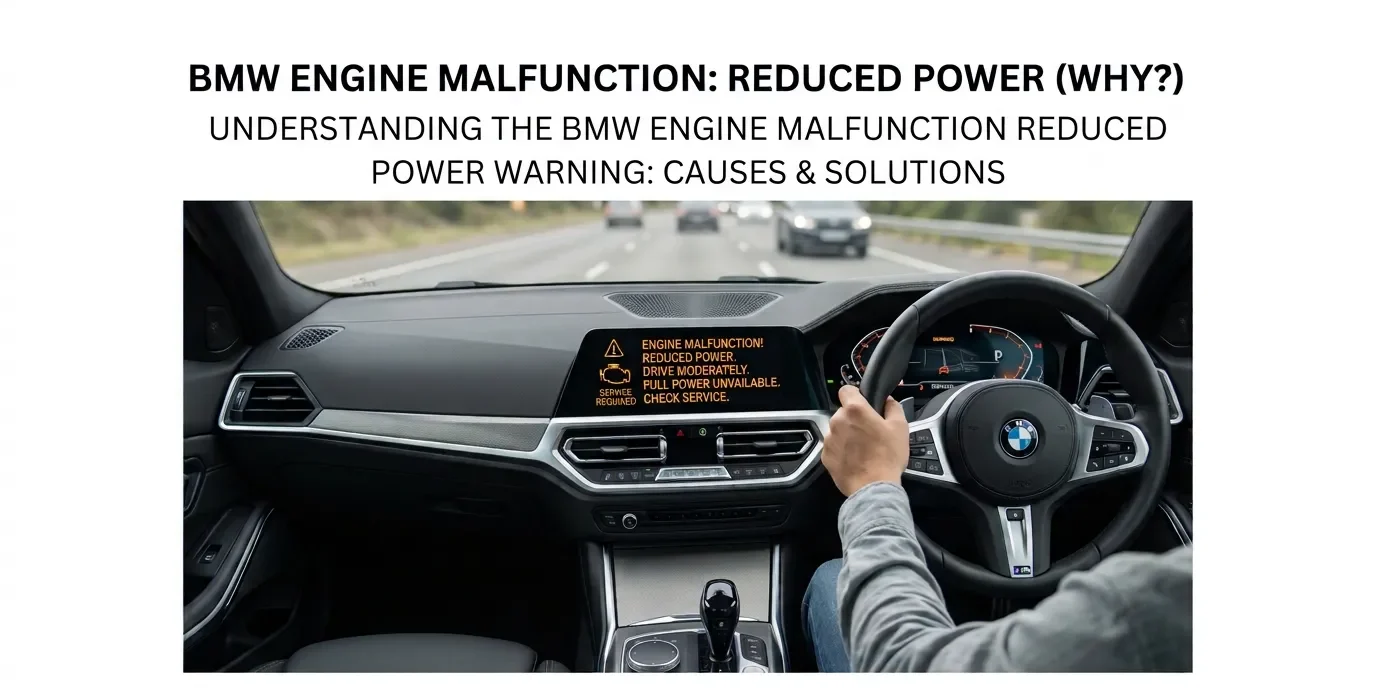
When your BMW displays the engine malfunction reduced power warning, it means the engine management system has detected a fault that may affect performance or safe operation.
BMW uses an engine control unit called the Digital Motor Electronics (DME) system to monitor important engine functions. These include fuel pressure, ignition timing, air intake, turbocharger boost, and engine temperature.
If the system detects readings outside the expected range, it may activate a protective operating mode commonly known as limp mode. This can reduce engine power, limit acceleration, or restrict engine speed to help prevent further damage.
The warning does not automatically mean your engine is damaged. However, it does mean the underlying fault needs proper investigation.
Common Symptoms of BMW Engine Malfunction Reduced Power
The warning can appear suddenly or develop alongside other performance problems. Depending on the fault, you may notice:
- Slow acceleration: Your BMW takes longer to reach normal speed, even when you press the accelerator.
- Limited engine power: The vehicle struggles when climbing hills or overtaking.
- Rough idling: The engine shakes or vibrates while the vehicle is stationary.
- Poor throttle response: The accelerator feels less responsive than usual.
- Turbocharger performance issues: Your BMW may lose its usual pulling power.
- Repeated dashboard warnings: The warning disappears after restarting but returns during driving.
For example, a BMW X5 that suddenly struggles to accelerate on Sheikh Zayed Road may have a boost pressure problem, fuel delivery issue, or ignition fault. The symptoms can look similar, but the correct repair depends on diagnostic results.
7 Common Reasons Your BMW Engine Goes Into Reduced Power Mode
Several engine and electronic components can trigger this warning. Here are seven areas that deserve attention during BMW engine diagnostics.
1. Faulty Ignition Coils or Worn Spark Plugs
Ignition coils and spark plugs work together to create the spark needed to burn the air and fuel mixture inside the engine.
When an ignition coil becomes weak or a spark plug wears out, the engine may misfire. You might notice shaking, hesitation, poor acceleration, or an engine warning light.
A mechanic can check cylinder-specific misfire codes and perform further ignition tests before replacing components.
2. Turbocharger or Boost Pressure Problems
Many BMW petrol engines use turbochargers to improve engine performance. The turbocharger increases the amount of air entering the engine, allowing it to produce more power.
A damaged charge pipe, leaking intake hose, faulty boost pressure sensor, or turbocharger control problem can prevent the system from reaching the required boost pressure.
Common signs include:
- Sudden loss of acceleration.
- Whistling or unusual air noises.
- Weak performance during acceleration.
- Engine malfunction or boost-related fault codes.
A smoke test and boost pressure checks can help identify leaks or control problems without immediately replacing the turbocharger.
3. High-Pressure Fuel Pump Failure
Your BMW engine needs a steady fuel supply at the correct pressure. The high-pressure fuel pump delivers fuel to the direct injection system at the pressure required by the engine.
If the pump becomes weak, the engine may struggle during acceleration, take longer to start, or lose power under heavy load.
A workshop should compare actual fuel pressure with the required pressure using diagnostic equipment. Replacing the pump without confirming the fault can lead to unnecessary expenses.
4. Engine Cooling System Problems
Dubai’s hot weather and heavy traffic can put additional demands on a BMW’s cooling system.
A failing electric water pump, faulty thermostat, coolant leak, or restricted coolant flow can cause engine temperatures to rise. Depending on the vehicle and fault, the engine management system may reduce performance to help protect the engine.
If you notice a rising temperature reading, coolant warning, or overheating, stop safely and switch off the engine when appropriate. Do not continue driving an overheating BMW.
5. Faulty VANOS Solenoids
BMW VANOS technology adjusts camshaft timing to improve engine performance, efficiency, and power delivery.
When VANOS solenoids become contaminated, restricted, or electrically faulty, the engine may not receive the correct camshaft timing adjustments.
Possible symptoms include rough idling, hesitation, reduced acceleration, and engine warning messages.
A technician should inspect the relevant fault codes, oil condition, electrical connections, and VANOS operation before deciding whether cleaning or replacement is necessary.
6. Valvetronic System Malfunction
Valvetronic controls the amount of air entering certain BMW engines by adjusting intake valve lift.
A faulty Valvetronic motor, eccentric shaft sensor, wiring connection, or related component can affect throttle response and engine performance.
Your BMW may develop an unstable idle, poor acceleration, or reduced power warning. A BMW-specific diagnostic scan can help identify whether the problem comes from the motor, sensor, wiring, or mechanical operation.
7. Weak Battery or Electrical System Fault
Modern BMW vehicles depend on stable electrical power to operate their engine management systems and electronic components.
A weak battery, charging system issue, damaged ground connection, or voltage irregularity can trigger multiple warning messages.
However, a battery warning should not automatically be treated as the cause of every engine malfunction. A proper battery health test and charging system inspection can help rule out electrical problems.
BMW Reduced Power Mode: Causes and Possible Symptoms
| Possible cause | Common symptoms | Recommended inspection |
|---|---|---|
| Ignition coil or spark plugs | Engine shaking and misfires | Ignition and misfire testing |
| Turbocharger boost leak | Weak acceleration and air noise | Smoke and boost pressure test |
| High-pressure fuel pump | Poor acceleration and starting issues | Fuel pressure testing |
| Cooling system fault | Rising engine temperature | Cooling system inspection |
| VANOS malfunction | Rough idle and hesitation | VANOS and oil system diagnosis |
| Valvetronic fault | Poor throttle response | Motor and sensor testing |
| Battery or charging issue | Multiple electronic warnings | Battery and alternator testing |
These are possible diagnostic directions, not confirmed diagnoses. Different BMW engines can produce similar symptoms for different reasons.
How Do Mechanics Diagnose BMW Engine Malfunction Reduced Power?
Finding the actual cause is more important than simply clearing the warning. A professional BMW diagnostic process should identify the fault, confirm it through testing, and check that the repair has restored normal operation.
At Car Garage Auto Services, the recommended diagnostic approach includes the following checks:
1. BMW-specific computer diagnostics
The technician scans the relevant control modules to retrieve stored fault codes and identify which systems require further investigation.
2. Live engine data inspection
Important readings such as fuel pressure, boost pressure, engine temperature, and misfire activity are checked against expected values.
3. Physical component inspection
The mechanic checks intake hoses, wiring, ignition components, connectors, and other parts related to the stored fault codes.
4. Targeted component testing
Depending on the results, additional tests may include a smoke test, fuel pressure test, electrical testing, or cooling system pressure test.
5. Repair verification
After the confirmed fault is repaired, the technician checks for returning fault codes and verifies engine operation under suitable driving conditions.
BMW’s own technical training material highlights the importance of identifying the actual cause instead of replacing components based only on symptoms. bmwtechinfo.bmwgroup.com+1
Can You Drive Your BMW With Reduced Engine Power in Dubai?
You should avoid unnecessary driving when your BMW displays this warning. Whether you can drive a short distance depends on the severity of the fault and how the engine behaves.
If the warning is yellow, the engine runs smoothly, and there are no signs of overheating or unusual noises, a short, gentle drive to a nearby workshop may be possible.
However, stop in a safe place and arrange recovery if you notice:
- A red engine warning or severe power loss.
- Heavy engine shaking or a flashing engine warning light.
- Rising engine temperature or an overheating warning.
- Smoke, burning smells, or fuel leakage.
- Sudden loss of vehicle control or unsafe acceleration.
Dubai’s busy roads make unexpected power loss particularly dangerous. Avoid high-speed driving and hard acceleration until the problem has been checked.
How Much Does BMW Reduced Power Repair Cost in Dubai?
The cost of repairing a BMW engine malfunction reduced power warning depends on the faulty component, BMW model, engine type, and labour involved.
A simple ignition issue may require less work than a high-pressure fuel system or turbocharger repair. Electrical faults can also require additional testing before the correct repair becomes clear.
The following factors usually affect your repair estimate:
- BMW model and engine: A BMW 320i, 530i, X5, and M5 have different engine configurations and repair requirements.
- Replacement parts: Genuine BMW parts and quality aftermarket alternatives may have different prices.
- Labour requirements: Some components are easier to access than others.
- Additional damage: Delaying repairs can allow a relatively small problem to affect other engine components.
At Car Garage Auto Services, the sensible approach is to identify the fault first, explain the required repair, and provide a clear estimate before work begins. This helps you avoid paying for unnecessary component replacements.
How to Prevent BMW Engine Power Problems
Regular maintenance can reduce the risk of engine performance issues and help identify developing faults before they become expensive repairs.
Here are some practical maintenance habits for BMW owners in Dubai:
- Follow the correct oil service schedule. Use engine oil that meets the specifications for your particular BMW engine.
- Inspect the cooling system regularly. Check coolant levels, hoses, the water pump, and thermostat condition.
- Maintain the ignition system. Replace spark plugs according to the recommended service interval and inspect ignition coils when symptoms appear.
- Check the intake and turbocharger system. Look for damaged hoses, loose connections, and boost leaks.
- Test your battery and charging system. A healthy electrical system helps prevent voltage-related problems.
- Address dashboard warnings early. Do not repeatedly clear warning messages without investigating their cause.
Dubai’s heat, dust, and stop-and-go traffic can make regular vehicle inspections especially valuable. Preventive maintenance helps keep your BMW dependable throughout the year.
BMW Engine Malfunction Reduced Power Repair at Car Garage Auto Services, Dubai
Experiencing a BMW engine malfunction reduced power warning can be frustrating, especially when your vehicle suddenly loses acceleration during everyday driving.
At Car Garage Auto Services, we help BMW owners in Dubai investigate engine performance issues through systematic diagnostics and professional repair services.
Whether your BMW is experiencing rough idling, turbocharger problems, fuel delivery issues, ignition misfires, or repeated engine warnings, the first step is to identify the underlying cause.
Our BMW engine diagnostic and repair services can help with:
- BMW engine computer diagnostics.
- Engine malfunction warning investigation.
- Ignition coil and spark plug inspection.
- Turbocharger and boost leak diagnosis.
- Fuel system inspection and repair.
- Cooling system repairs.
- Engine performance troubleshooting.
Rather than replacing parts based on assumptions, we focus on identifying the fault and recommending the appropriate repair.
If your BMW is showing reduced power in Dubai, arrange a diagnostic inspection with Car Garage Auto Services before the problem becomes more serious.
Book your BMW engine inspection today and get your vehicle’s performance checked by experienced automotive technicians.
Frequently Asked Questions
1. What does BMW Engine Malfunction Reduced Power mean?
It means your BMW’s engine management system has detected a fault that may affect engine performance. The vehicle may activate a protective mode that limits engine power or acceleration until the underlying issue is diagnosed.
2. Can a faulty spark plug cause BMW reduced power?
Yes. A worn spark plug or failing ignition coil can cause engine misfires. The engine management system may respond by limiting performance to protect components such as the catalytic converter.
3. Why does my BMW reduced power warning disappear after restarting?
Restarting can temporarily remove the warning from the dashboard if the fault is no longer actively detected. However, stored fault codes may remain in the control unit, and the problem can return. A diagnostic scan is still recommended.
4. Can a turbocharger problem cause reduced engine power?
Yes. A boost leak, faulty boost pressure sensor, or turbocharger control problem can prevent the engine from receiving the required boost pressure. This can lead to poor acceleration and reduced engine performance.
5. Where can I get BMW reduced power diagnostics in Dubai?
You can contact Car Garage Auto Services in Dubai for BMW engine diagnostics and repair assistance. A proper inspection helps identify whether the problem involves ignition, fuel delivery, turbocharging, cooling, or another engine management component.