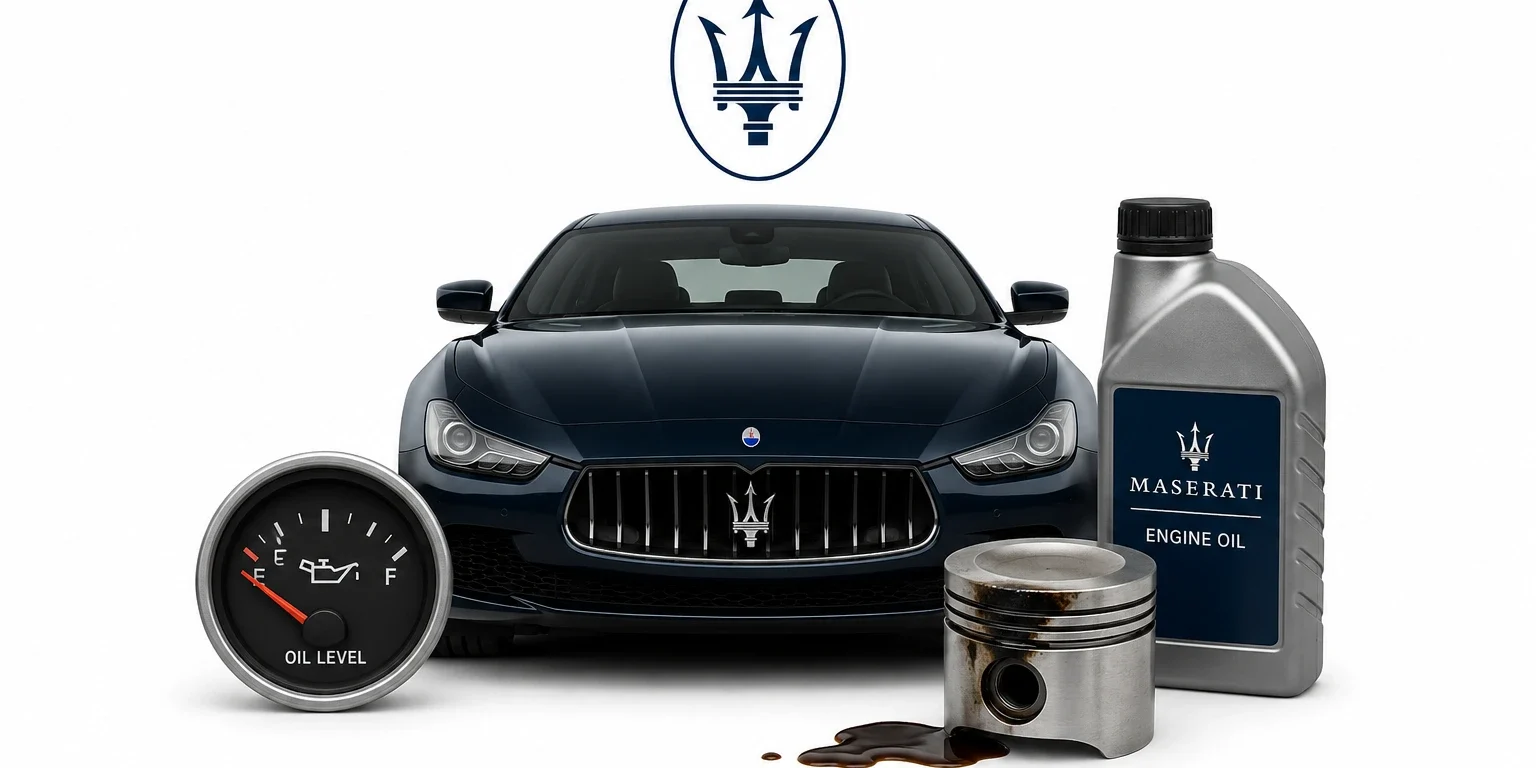
I’ve been under the hood of enough Ghiblis, Levantes, and Quattroportes in this city to know one thing for certain. When a Maserati owner tells me “I just keep topping up the oil,” it’s rarely a coincidence and almost never something to shrug off. Maserati oil consumption problems in Dubai show up more often than owners expect, and the heat here has a way of exposing weaknesses that would stay hidden in a milder climate. In this guide, I’ll walk you through what I actually look for when a Maserati comes into the bay with this complaint, what tends to be behind it, and a few real examples from our workshop floor.
A Little Oil Use Is Normal. This Isn’t That.
Every performance engine burns a small amount of oil. That’s baked into the design. Tight tolerances and high revving engines, the kind Maserati builds its reputation on, will always sip a bit more than your average commuter car.
What I tell clients at Car Garage Expert is this. If you’re checking the dipstick and it’s dropped noticeably between services, or you’ve had to add oil more than once in a month, that’s not “normal Maserati behavior.” That’s a car trying to tell you something.
Dubai adds pressure to the equation. Ambient temperatures pushing past 45°C in summer, hours of idling in traffic with the AC working overtime, and fine dust that finds its way into every seal and hose, all of it accelerates wear that would take years longer to show up somewhere cooler. I’ve pulled valve cover gaskets on cars barely five years old that looked like they’d done double the mileage, purely because of how hard the climate works them.
What Counts as Excessive Oil Consumption?
Most manufacturers consider anything beyond roughly a liter of oil use between full service intervals worth investigating. If you’re topping up more frequently than that, seeing blue smoke, or getting a low oil warning, the engine needs a proper look rather than another top up.
The Symptoms I Look For First
Before I even open the hood, I ask the owner a few questions, because the pattern of symptoms usually points me in the right direction.
- Repeated top ups. This is almost always the first clue an owner notices.
- Blue or grey smoke on startup or acceleration. Different timing tells me different things. Smoke right after a cold start often points toward valve stem seals. Smoke under hard acceleration leans more toward piston rings or a turbo issue.
- A burnt oil smell in the cabin or engine bay. Usually oil landing on a hot surface, which tells me to go hunting for an external leak first.
- A low oil pressure warning. I never let this wait. It means the engine may be running with inadequate lubrication right now, not eventually.
- Rough idle or a slight misfire. Oil fouled plugs are a classic sign that oil is getting into the combustion chamber somewhere.
- A stain under the car. Sometimes obvious, sometimes just a faint residue that tells me exactly where to start looking.
What’s Actually Causing the Oil Loss
Here’s where I try to slow owners down. There’s no single “Maserati oil consumption fix.” The cause has to be found before any part gets replaced.
Worn piston rings. Rings control how much oil reaches the cylinder walls while maintaining compression. Once they wear, oil slips past into combustion and burns off, usually showing as blue smoke under load.
Deteriorated valve stem seals. These seals age and harden faster in extreme heat. Once they go, oil seeps down into the cylinder, which is why I often see smoke that’s heaviest right after startup and clears as the engine warms.
A failing PCV system. The crankcase ventilation system manages pressure inside the engine, and when a valve, separator, or hose fails, oil vapor gets pulled into the intake in far larger amounts than it should. AA1Car’s technical breakdown of PCV systems is one of the clearer explanations I’ve come across for how blow by gases lead to oil consumption when this system fails, and it matches what I see on the bench.
Turbocharger seal wear. Turbocharged Maserati engines lean on engine oil to lubricate the turbo bearings. Garrett Motion, one of the largest turbocharger manufacturers in the world, publishes a solid explanation of how turbo oil and gas sealing actually works, and one point they make is worth repeating here. A lot of oil leaks get blamed on a turbo that’s actually fine, when the real fault sits somewhere else in the system. That’s exactly why I don’t jump straight to “replace the turbo” without testing first.
External leaks. Valve cover gaskets, oil pan seals, and oil cooler lines are the usual suspects. Oil often burns off before it hits the ground, so a real leak can go unnoticed longer than owners expect.
The wrong oil specification. Using oil that doesn’t match Maserati’s viscosity and performance requirements affects how well the engine is protected, and I’ve seen this alone accelerate consumption on an otherwise healthy engine.
Case Notes From Our Workshop
A few examples from recent jobs, shared without identifying details, give a better sense of how this plays out in practice.
The Levante with the mystery smoke. An owner brought in a Levante after noticing light smoke on cold starts and a slightly rough idle for the first few minutes each morning. Spark plugs showed light oil fouling on two cylinders. A leak down test confirmed worn valve stem seals rather than piston ring wear, which meant a far less invasive repair than the owner had feared.
The Quattroporte that “just needed oil.” This car had been topping up roughly a liter every two weeks for months with no visible puddles anywhere. A pressure test on the crankcase ventilation system found a cracked oil separator housing, a part easy to miss without the right diagnostic sequence. Once replaced, consumption dropped back to normal within one service cycle.
The Ghibli with the turbo scare. An owner assumed the worst after reading online that oil consumption always means turbo failure. On inspection, the actual source was a deteriorated valve cover gasket dripping onto the exhaust manifold, producing a burning smell that mimicked turbo trouble. No turbo work was needed at all.
The lesson across all three is the same one I repeat to every Maserati owner who walks in worried. The symptom rarely tells you the cause on its own.
How I Actually Diagnose It
Guessing wastes money on parts that were never the problem. My process usually runs through oil level and condition checked against service history, an electronic scan for stored fault codes, a full visual inspection for external leaks, a check of the PCV and intake system, a look at spark plug condition, and where needed, a compression or leak down test. On turbocharged models, I also check the oil feed and return lines to the turbo before assuming the turbo itself is at fault.
Why Dubai Makes This Worse
Heat breaks down rubber and synthetic seals faster than most owners realize, and a gasket that might last comfortably for years in a cooler climate can degrade well ahead of schedule here, especially in a car that spends a lot of time idling in traffic. Dust adds another layer, working into filters and components that need regular attention. This is exactly why we see Maserati owners in Dubai dealing with oil consumption complaints earlier in a car’s life than the manufacturer’s own service intervals might suggest.
What You Can Do Between Visits
- Check the oil level manually every couple of weeks rather than relying only on the dashboard reading.
- Use only the oil specification listed for your specific Maserati engine.
- Get small leaks looked at as soon as you spot them, rather than waiting for the next scheduled service.
- Pay attention to exhaust smoke, especially on cold starts or hard acceleration.
- Keep a simple log of mileage and oil added. It gives your mechanic real data instead of a guess.
Book a Proper Inspection
If your Maserati has been asking for oil more often lately, or you’ve noticed smoke, a burning smell, or a warning light, get it checked by a shop that actually works on Italian performance engines day to day. At Car Garage Expert, our engine diagnostics and repair team has handled oil consumption cases across Ghibli, Levante, Quattroporte, and GranTurismo models, with a diagnostic approach built specifically around Dubai’s heat and traffic conditions.
We also offer scheduled oil changes using the correct specification for your engine, a full vehicle inspection service if you want a health check before a long drive, and ongoing car maintenance packages built to catch small leaks before they become expensive ones. If your car ever needs to come to us rather than the other way around, our roadside assistance service covers Al Quoz and the surrounding areas. You can read more about who we are on our about us page, or reach out directly through our contact page to book an inspection.
Frequently Asked Questions
How much oil consumption is normal for a Maserati? A well maintained engine may use up to around a liter between full service intervals. Beyond that, or a pattern of needing frequent top ups, it’s worth having the engine checked rather than continuing to top up.
Can I keep driving if my Maserati is low on oil? Short, gentle drives with the level still in range and no warning lights are generally lower risk, but any oil pressure warning, heavy smoke, or unusual noise means you should stop and have it inspected right away.
Does blue smoke always mean I need a new engine? No, and this is the assumption I correct most often. Blue smoke can come from worn piston rings, valve stem seals, a PCV fault, or turbocharger seals, and several of these repairs are far less involved than a full rebuild. Only proper testing tells you which one you’re actually dealing with.
Final Word From the Bay
Oil consumption problems rarely fix themselves, and in Dubai’s climate, small issues tend to progress faster than most owners expect. Paying attention to the early signs, checking your oil regularly, and getting a proper diagnosis at the first hint of trouble can save you from a much bigger repair bill down the line. If your Maserati has been going through oil faster than it should, don’t wait for the warning light. Book a diagnostic inspection with Car Garage Expert and find out exactly what’s going on before it becomes a bigger problem.