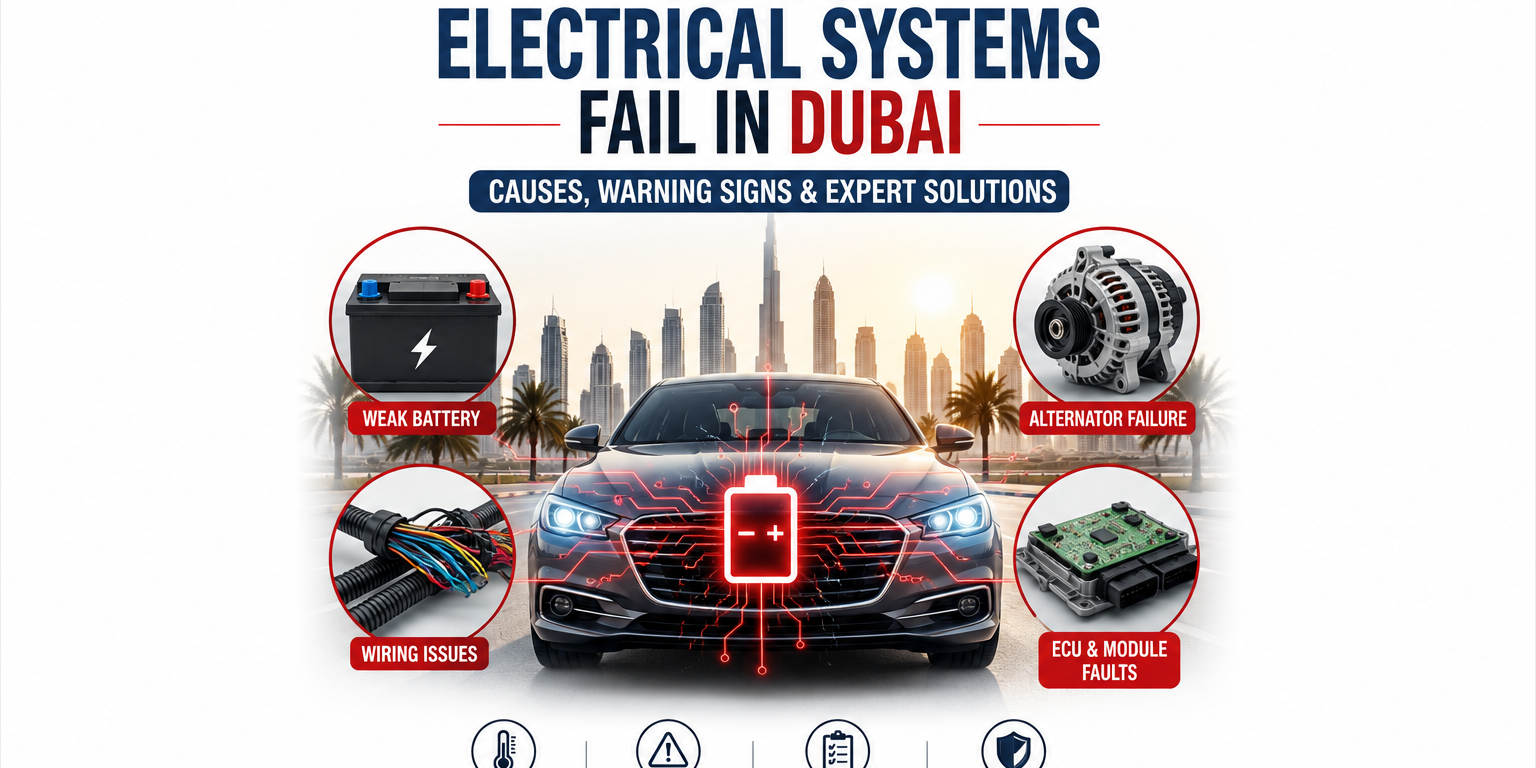
If you have ever faced a dead battery, flickering dashboard lights, or a car that suddenly refused to start, you are not alone. These are some of the most common problems drivers experience in Dubai, especially during the summer months. While many people believe these issues happen because a car is old, the real reason is often the harsh environment. The combination of extreme heat, heavy traffic, dust, and continuous air conditioner use puts extra pressure on every electrical component. That is why car electrical systems fail in Dubai much faster than they do in many other parts of the world.
Modern vehicles depend on electricity more than ever before. Starting the engine is only one small part of the job. Your battery powers the starter motor, the alternator keeps the battery charged, and dozens of electronic modules control everything from the engine and transmission to the air conditioning and safety systems. Even simple features like power windows, parking sensors, infotainment screens, and central locking rely on a healthy electrical system. When one component starts to fail, it can affect several other parts of the vehicle, leading to expensive repairs if the problem is ignored.
Dubai’s climate makes this challenge even greater. A car parked outside in areas such as Al Quoz, Business Bay, Downtown Dubai, Dubai Marina, or Jumeirah can remain under direct sunlight for several hours. During this time, the temperature inside the engine bay becomes much higher than the outside temperature. As a result, electrical components are exposed to constant heat stress, which gradually reduces their performance and shortens their lifespan. Over time, this daily exposure can lead to battery failure, damaged wiring, charging problems, and faults in important electronic control units.
The good news is that most electrical problems do not appear without warning. Your vehicle usually gives clear signs before a complete failure occurs. By understanding how your electrical system works and recognizing these early symptoms, you can fix small issues before they turn into major repairs. In this guide, you will learn why car electrical systems fail in Dubai, the warning signs to watch for, the most common causes of electrical failures, and the best ways to keep your vehicle reliable throughout the year.
Understanding Your Car’s Electrical System
Before learning why electrical failures are common in Dubai, it is important to understand how your vehicle’s electrical system works. Many drivers think the battery is the only electrical component in a car, but that is far from the truth. Every modern vehicle contains hundreds of electrical circuits that work together every time you start the engine or drive on the road. From turning on the headlights to operating advanced driver assistance features, almost every function depends on a stable supply of electricity.
All of these components are connected like members of one team. If one part becomes weak or stops working, the entire system can be affected. For example, a failing alternator may prevent the battery from charging correctly. A weak battery can then cause voltage drops, leading to false sensor readings or warning lights on the dashboard. This is why professional technicians always inspect the complete electrical system instead of replacing only one part.
The Battery
The battery is the heart of your car’s electrical system. Its main job is to store electrical energy and provide the power needed to start the engine. Once the engine is running, the battery also helps stabilize voltage and supports electrical components whenever extra power is required.
In Dubai, the battery works much harder than many drivers realize. Every journey usually begins with the air conditioner running at full power, especially during the summer. Features such as cooling fans, infotainment systems, navigation screens, charging ports, and LED lighting also consume electricity. Because of this constant demand, batteries in Dubai often have a shorter lifespan than those used in cooler climates. Even a high-quality battery can lose efficiency more quickly if it is regularly exposed to extreme heat without proper maintenance.
The Alternator
While the battery starts the vehicle, the alternator keeps it running. As soon as the engine starts, the alternator generates electricity and recharges the battery at the same time. It also supplies power to essential systems such as the headlights, climate control, engine management system, and electronic accessories.
If the alternator becomes weak, the battery slowly loses its charge because it is no longer receiving enough electricity. Many people replace the battery when their car refuses to start, only to discover that the real problem is a failing alternator. This is why charging system inspections are an important part of electrical diagnostics, especially for vehicles that spend long hours driving in heavy Dubai traffic.
The Starter Motor
Every time you turn the key or press the start button, the starter motor begins turning the engine so it can start running. Although this process only lasts a few seconds, it requires a large amount of electrical power from the battery. If either the battery or the starter motor is weak, the engine may crank slowly or fail to start altogether.
A healthy starter motor should operate smoothly without unusual noises. Clicking sounds, slow cranking, or repeated starting attempts often indicate that the electrical starting system needs professional attention. Ignoring these early signs can eventually leave you stranded without warning.
Wiring Harness, Fuses, and Relays
Behind the dashboard and inside the engine bay, thousands of electrical wires carry power between different components. These wires are grouped together in what is known as the wiring harness. They connect the battery, alternator, sensors, control modules, lighting system, and every electrical accessory in the vehicle.
To protect these circuits, manufacturers install fuses and relays. A fuse acts as a safety device that breaks the circuit if too much current flows through it. This prevents expensive electrical components from being damaged. Relays work like automatic switches, allowing small electrical signals to control larger electrical loads safely. When wiring becomes damaged or a fuse blows repeatedly, it usually points to a deeper electrical problem that should be diagnosed instead of simply replacing the fuse.
Electronic Control Units
Modern cars are controlled by several electronic computers instead of mechanical systems alone. These computers constantly communicate with one another and make thousands of decisions every minute while you drive. They monitor engine performance, fuel delivery, braking, transmission shifting, air conditioning, and many other functions that improve safety and driving comfort.
Because these control modules rely on stable voltage, even a small electrical fault can create unexpected problems. A weak battery, poor ground connection, or damaged alternator may cause communication errors between different modules, leading to warning lights or unusual vehicle behavior. This is one of the reasons why electrical diagnostics have become much more important in today’s vehicles than they were just a decade ago.
Why Dubai’s Climate Damages Car Electrical Systems
Every vehicle experiences normal wear and tear, but Dubai’s environment speeds up this process. The city’s climate is one of the toughest in the world for automotive electrical components because heat, dust, humidity, and heavy traffic all work together to reduce their lifespan. Even a well-maintained vehicle can develop electrical problems earlier than expected if these conditions are ignored.
Unlike mechanical parts that mainly wear through movement, electrical components are highly sensitive to temperature. Heat changes the way electricity flows through wires and electronic circuits. It also causes plastic connectors, rubber insulation, and delicate electronic boards to age much faster. As these materials become weaker, the chances of electrical failure increase with every passing summer.
Extreme Heat Creates Constant Stress
High temperatures are the biggest reason why car electrical systems fail in Dubai. During the hottest months, the outside temperature can exceed 45°C, while the engine bay often becomes much hotter after driving. When a vehicle is parked under direct sunlight for several hours, electrical components remain exposed to this heat even after the engine has been switched off.
This continuous cycle of heating and cooling slowly damages batteries, wiring insulation, sensors, and electronic modules. Plastic connectors may become brittle, rubber seals can crack, and electrical resistance inside the circuits gradually increases. Although these changes happen slowly, they eventually affect the overall reliability of the vehicle.
Air Conditioning Increases Electrical Load
The air conditioner is one of the most frequently used systems in Dubai. For most drivers, it starts working as soon as the engine is turned on and continues running throughout the journey. While it keeps the cabin comfortable, it also places a heavy demand on the electrical system.
The blower motor, cooling fans, climate control module, and compressor controls all require electricity to operate efficiently. At the same time, drivers often use navigation systems, mobile phone chargers, entertainment screens, and other accessories. This constant demand means the battery and alternator rarely get a chance to work under light conditions, which accelerates wear over time.
Why Car Batteries Fail Faster in Dubai
The battery is one of the hardest-working parts of your vehicle, especially in Dubai. While many drivers expect a car battery to last four or five years, the reality is often very different. Because of the city’s extreme temperatures, many batteries begin losing their performance much earlier than expected. This is one of the biggest reasons why car electrical systems fail in Dubai, as a weak battery can affect almost every electrical component in the vehicle. What starts as a simple battery problem can quickly lead to starting issues, dashboard warning lights, and poor performance from other electrical systems.
Heat is much more damaging to a battery than cold weather. Inside every battery is a chemical reaction that stores and delivers electrical energy. High temperatures speed up this reaction, causing the battery fluid to evaporate more quickly and the internal plates to wear out faster. As the battery ages, it can no longer hold a full charge, even if the alternator is working properly. This is why many drivers are surprised when their car suddenly refuses to start after only two or three years of normal use.
Another reason batteries fail faster in Dubai is the heavy electrical demand placed on them every day. Most journeys begin with the air conditioner running at full power, while other systems such as the infotainment screen, navigation, headlights, cooling fans, parking sensors, and mobile charging ports also consume electricity. During stop-and-go traffic, the alternator may not generate enough power to meet all these demands, forcing the battery to provide additional energy. Over time, this repeated cycle places extra stress on the battery and shortens its lifespan.
Many drivers ignore the early warning signs of a weak battery because the symptoms often appear gradually. The engine may crank a little slower each morning, the headlights may seem slightly dimmer than usual, or the dashboard may display a battery warning light for a few seconds. These small changes are easy to overlook, but they often indicate that the battery is approaching the end of its service life. Having the battery tested during routine servicing can help identify the problem before it leads to a complete breakdown.
Regular battery inspections are especially important in Dubai because preventive maintenance is much cheaper than emergency repairs. Cleaning the battery terminals, checking the charging system, and replacing an ageing battery before it fails can save both time and money. A healthy battery also protects other electrical components by providing a stable voltage, reducing the risk of unnecessary wear on the alternator and electronic control modules.
How Heat Damages the Alternator
Although the battery receives most of the attention, the alternator plays an equally important role in your vehicle’s electrical system. Once the engine starts, the alternator becomes the main source of electrical power. It charges the battery while also supplying electricity to essential systems such as the headlights, air conditioning, engine management system, power steering, and electronic safety features. If the alternator cannot generate enough power, the entire electrical system begins to suffer.
Dubai’s hot climate places continuous pressure on the alternator. Every time you drive, it must work harder to support the air conditioner, cooling fans, infotainment system, and many other electrical accessories. At the same time, the engine bay operates at extremely high temperatures, making it difficult for the alternator to stay cool. This constant workload gradually increases wear on its internal components and reduces its efficiency.
One of the most common alternator problems is a failing voltage regulator. The voltage regulator controls the amount of electricity sent to the battery and other electrical systems. When it stops working correctly, the battery may receive either too much or too little voltage. Overcharging can damage the battery, while undercharging leaves it without enough power to start the vehicle. Both situations can create a chain reaction that affects the entire electrical system.
The alternator also contains bearings that allow it to spin smoothly while the engine is running. Continuous exposure to heat can cause these bearings to wear out more quickly. As they deteriorate, drivers may hear unusual whining or grinding noises from the engine bay. Ignoring these sounds can eventually lead to complete alternator failure, leaving the battery unable to recharge.
Another important component inside the alternator is the diode pack. Diodes convert alternating current into direct current so the battery and electrical systems can use it safely. Excessive heat can damage these diodes, reducing the alternator’s ability to produce stable electrical power. This often results in flickering headlights, battery warning lights, weak electrical performance, and repeated battery failures.
Because battery and alternator problems are closely connected, replacing one without testing the other is rarely the right solution. Professional electrical diagnostics should always include a complete charging system inspection. This allows technicians to determine whether the battery, alternator, or another electrical component is causing the problem.
Wiring Problems Caused by Dubai’s Heat
The wiring harness is one of the largest parts of any vehicle, yet it is often overlooked until something goes wrong. Thousands of wires run throughout the car, connecting the battery, alternator, sensors, lighting system, engine, transmission, and electronic control modules. These wires constantly carry electrical signals that allow different systems to communicate with one another. Even a small amount of damage can interrupt this communication and create unexpected electrical faults.
Dubai’s extreme temperatures have a significant impact on automotive wiring. Most wires are protected by plastic insulation that keeps electricity flowing safely through the circuit. However, years of exposure to intense heat can cause this insulation to become dry, brittle, and cracked. Once the protective covering begins to break down, the wires become more vulnerable to damage from vibration, moisture, and accidental contact with other components inside the engine bay.
Dust and fine sand create another challenge for electrical connections. Small particles can enter wiring connectors and sensor plugs, reducing the quality of the electrical contact. As dirt builds up over time, resistance inside the circuit increases, making it harder for electricity to flow smoothly. This may cause intermittent faults that appear and disappear without warning, making them difficult to diagnose without proper equipment.
Engine vibration also contributes to wiring problems. Every time the vehicle is driven, the engine and surrounding components move slightly. After thousands of kilometres, repeated vibration can loosen connectors or create tiny breaks inside the wiring harness. These faults may only appear under certain driving conditions, which is why they often confuse drivers and inexperienced technicians.
Ground connections are another common source of electrical problems. Every electrical circuit needs a secure path back to the battery. If a ground connection becomes loose or corroded, voltage drops may occur throughout the system. This can lead to dim lights, malfunctioning sensors, communication errors between control modules, and even starting problems.
Because wiring faults often affect multiple systems at the same time, replacing individual parts rarely solves the issue. A professional technician uses specialised electrical testing equipment to trace the problem back to its source. Finding and repairing damaged wiring early helps prevent more serious electrical failures later.
ECU and Electronic Module Failures
Modern vehicles rely on advanced electronics far more than older cars. Instead of using only mechanical parts, today’s vehicles contain several electronic control modules that monitor and manage almost every driving function. These computers work together every second, processing information from dozens of sensors and making instant adjustments to improve performance, fuel efficiency, comfort, and safety.
The Engine Control Unit, commonly known as the ECU, is one of the most important computers in the vehicle. It controls fuel injection, ignition timing, engine performance, and emissions. Other modules, such as the Body Control Module, Transmission Control Module, ABS Control Module, and Airbag Control Module, each manage different systems while constantly exchanging information through the vehicle’s communication network.
Because these modules depend on clean and stable electrical power, they are highly sensitive to voltage fluctuations. A weak battery, failing alternator, damaged wiring, or poor ground connection can all affect the way these computers operate. Instead of failing completely, they often begin producing confusing symptoms such as warning lights, communication errors, poor engine performance, or unexpected electronic malfunctions.
Heat also affects electronic modules over time. Every control unit contains delicate circuit boards and microscopic electronic components that expand and contract as temperatures change. After years of repeated heat exposure, tiny cracks can develop in solder joints or internal circuits. Although these faults may begin as occasional problems, they often become more frequent until the module eventually stops working altogether.
Many drivers assume that every warning light means the ECU itself has failed, but this is rarely the case. In many situations, the control module is working correctly and is simply reporting a fault somewhere else in the electrical system. This is why replacing expensive electronic modules without proper testing can lead to unnecessary repair costs.
Professional diagnostics allow technicians to read fault codes, test communication between different modules, measure voltage levels, and inspect the complete electrical system before replacing any components. This systematic approach helps identify the real cause of the problem and ensures that repairs are both accurate and cost-effective.
As vehicles continue to become more advanced, electronic systems will play an even bigger role in everyday driving. Regular electrical inspections and early diagnosis are therefore essential for keeping these systems reliable, especially in Dubai’s demanding climate, where extreme temperatures place additional stress on every electronic component.
Most Common Car Electrical Problems in Dubai
Electrical problems can appear in many different ways. Sometimes the symptoms are easy to notice, while other times they develop slowly over several weeks or months. Because modern vehicles connect almost every system through electronics, a fault in one component can create problems in several other areas. Understanding the most common electrical issues can help you recognise the warning signs early and avoid expensive repairs.
Dead Battery
A dead battery is one of the most common reasons drivers need roadside assistance in Dubai. In many cases, the battery has simply reached the end of its lifespan after years of working in extreme temperatures. However, a dead battery can also be caused by a failing alternator, a parasitic battery drain, or electrical accessories that continue using power after the engine has been switched off.
Many drivers replace the battery immediately without checking the rest of the charging system. While this may solve the problem temporarily, the new battery can fail again if the real cause is still present. This is why professional technicians always test the battery, alternator, and electrical circuits together before recommending any replacement.
Alternator Failure
The alternator supplies electricity to the vehicle while also keeping the battery fully charged. When it begins to fail, the battery slowly loses power until it can no longer start the engine. Before complete failure happens, most vehicles give several warning signs, including dim headlights, flickering dashboard lights, weak air conditioning performance, or a battery warning light on the instrument cluster.
Ignoring these symptoms can leave you stranded because the engine will eventually stop once the battery becomes completely discharged. Regular charging system inspections help identify alternator problems before they reach this stage.
Starter Motor Problems
The starter motor is responsible for turning the engine when you start the vehicle. Since it relies on a strong battery and healthy electrical connections, problems with any part of the starting system can affect its performance. Drivers often notice slow cranking, clicking noises, or repeated attempts before the engine finally starts.
Although these symptoms may appear similar to a weak battery, the actual cause could be worn starter motor components or poor electrical connections. Proper testing ensures that the faulty part is repaired instead of replacing components unnecessarily.
Damaged Wiring Harness
The wiring harness carries electrical power throughout the entire vehicle. Heat, vibration, ageing, and accidental damage can weaken the insulation or break wires inside the harness. These faults are often difficult to identify because they may only occur while driving over bumps or during certain weather conditions.
Damaged wiring can affect sensors, lighting systems, power windows, engine performance, or even the vehicle’s communication network. Since one damaged wire can interrupt several systems at once, detailed electrical testing is usually required to locate the exact fault.
Blown Fuses and Faulty Relays
Fuses and relays protect the electrical system from overload and help different components operate safely. A blown fuse normally indicates that too much current has passed through the circuit. Simply replacing the fuse without finding the reason it failed can result in the same problem happening again.
Relays also wear out over time because they switch electrical circuits on and off thousands of times during normal driving. A faulty relay may cause headlights, cooling fans, fuel pumps, or air conditioning systems to stop working even though the component itself is still in good condition.
Battery Terminal Corrosion
Battery terminals provide the connection between the battery and the rest of the electrical system. Over time, heat, moisture, and chemical reactions can create corrosion around these terminals. This white or bluish deposit restricts the flow of electricity and may cause starting problems, charging issues, or random electrical faults.
Cleaning battery terminals during routine servicing is a simple maintenance task that can prevent many electrical problems before they become serious.
Sensor and Electronic Communication Problems
Modern vehicles use dozens of sensors to monitor engine temperature, fuel pressure, air intake, wheel speed, braking performance, and many other systems. These sensors constantly send information to different control modules, allowing the vehicle to make adjustments in real time.
When voltage becomes unstable because of a weak battery, failing alternator, or damaged wiring, sensors may send incorrect information. This can trigger multiple warning lights even though the sensors themselves are not faulty. Professional diagnostics help identify whether the problem lies with the sensor, the wiring, or the vehicle’s electrical supply.
Which Cars Experience Electrical Problems More Often?
Every vehicle can develop electrical faults, but some cars contain far more electronic systems than others. Luxury vehicles, performance cars, and newer models are equipped with advanced technology that improves comfort, safety, and driving performance. While these features offer many benefits, they also increase the number of electrical components that require regular maintenance.
Brands such as Mercedes-Benz, BMW, Audi, Porsche, Land Rover, and Range Rover include sophisticated electronic control systems that manage everything from adaptive suspension and digital dashboards to intelligent lighting and driver assistance features. Because these vehicles contain more sensors, control modules, and communication networks, diagnosing electrical problems often requires advanced equipment and experienced technicians.
This does not mean these manufacturers build unreliable vehicles. In fact, many of them are known for excellent engineering and long-term durability. However, the complexity of their electrical systems means that even a small voltage problem can affect several features at the same time. A weak battery, for example, may trigger multiple warning lights even though the vehicle itself is mechanically sound.
Japanese manufacturers such as Toyota, Lexus, Nissan, and Honda are generally recognised for strong reliability. Even so, these vehicles are still affected by Dubai’s harsh climate. Heat does not discriminate between vehicle brands. Batteries, alternators, wiring harnesses, and electronic modules in every car experience additional stress when exposed to high temperatures year after year.
Electric and hybrid vehicles also rely heavily on advanced electronics. Along with the traditional 12-volt electrical system, these vehicles contain additional control units that monitor battery management, charging systems, regenerative braking, and power distribution. Because of this added complexity, regular electrical inspections become even more important for maintaining long-term reliability.
Rather than focusing only on the vehicle brand, drivers should pay attention to regular maintenance. A well-maintained vehicle with routine electrical inspections will usually experience fewer unexpected problems than a neglected car, regardless of its manufacturer.
Professional Electrical Diagnostics
Finding an electrical fault is very different from repairing a mechanical problem. A worn brake pad or damaged tyre is usually easy to see, but electrical faults often remain hidden behind panels, inside wiring harnesses, or within electronic control modules. For this reason, professional diagnostics play a vital role in identifying the real cause of the problem instead of relying on guesswork.
Many people believe that plugging a scan tool into the vehicle will immediately reveal the faulty part. While diagnostic scanners are valuable tools, they only provide fault codes that point technicians in the right direction. A fault code does not automatically mean the listed component needs replacement. It simply indicates where further testing should begin.
A complete electrical diagnosis starts with a visual inspection. Technicians check the battery condition, inspect wiring for signs of heat damage, examine connectors for corrosion, and look for loose ground connections. Many electrical faults can be identified during this initial inspection before advanced testing even begins.
The next step is battery and charging system testing. Special equipment measures battery health, charging voltage, and alternator performance under different operating conditions. This helps determine whether the electrical system is receiving stable power throughout the vehicle.
Voltage drop testing is another important procedure. Even if wires appear undamaged from the outside, they may have excessive electrical resistance inside. Measuring voltage drop across different circuits allows technicians to identify hidden wiring faults that cannot be seen during a visual inspection.
Parasitic battery drain testing is often performed when batteries repeatedly become flat overnight. During this procedure, technicians measure how much electricity the vehicle continues using after the engine has been switched off. If an electrical component remains active when it should not, it slowly drains the battery over several hours or days.
Modern vehicles also use communication networks that allow different control modules to exchange information. Professional diagnostic equipment checks whether these modules are communicating correctly. If one module stops responding, technicians can trace the communication fault back to damaged wiring, unstable voltage, or a failed electronic component.
This systematic approach reduces unnecessary repairs and helps ensure that only the faulty component is replaced. It also saves money because technicians solve the root cause of the problem rather than treating the symptoms.
How Professional Mechanics Find Hidden Electrical Faults
Electrical problems are rarely solved by replacing parts one after another. Experienced technicians follow a structured diagnostic process that allows them to identify the exact cause before any repairs begin. This method is especially important for modern vehicles because several different faults can produce the same warning signs.
The process usually begins with a detailed discussion with the vehicle owner. Information about when the problem occurs, how often it happens, and whether warning lights appear helps narrow the search. For example, a car that only struggles to start in the morning may have a different issue than one that loses electrical power while driving.
After gathering this information, technicians perform a complete visual inspection of the engine bay and electrical system. They examine the battery terminals, wiring harness, fuses, relays, connectors, and ground points for signs of corrosion, overheating, or physical damage. Even a loose connector can sometimes cause problems that appear much more serious than they really are.
Electronic diagnostic equipment is then connected to the vehicle to read fault codes and monitor live data from different control modules. Instead of relying only on stored error codes, technicians compare sensor readings, charging voltage, and communication signals while the engine is running. This provides a clearer picture of how the entire electrical system is performing.
Once the faulty circuit has been identified, individual components are tested using specialised electrical equipment. Only after confirming the exact source of the fault is the repair carried out. Finally, the vehicle is tested again to ensure every electrical system is operating correctly and that no new fault codes are present. This careful process provides a reliable repair and reduces the chances of the same problem returning in the future.
Can You Drive With an Electrical Problem?
Many drivers continue using their vehicles after noticing small electrical problems because the car still seems to drive normally. A dashboard warning light may appear for a few days, the headlights may flicker occasionally, or the engine may take an extra second to start. Since the vehicle is still moving, it is easy to assume that the problem is not serious. Unfortunately, this is one of the biggest mistakes a driver can make. Electrical faults rarely fix themselves. Instead, they usually become worse over time and may eventually leave you stranded without warning.
The level of risk depends on which part of the electrical system has failed. A loose battery terminal may only cause occasional starting problems at first, while a failing alternator can stop charging the battery completely. Once the battery runs out of power, the engine management system, fuel pump, ignition system, and other important components may stop receiving the electricity they need. At that point, the engine can stall while you are driving, creating a dangerous situation, especially on busy roads such as Sheikh Zayed Road or Al Khail Road.
Modern vehicles also rely on electricity for many important safety features. Systems such as Anti-lock Braking (ABS), Electronic Stability Control (ESC), electric power steering, parking sensors, airbags, and adaptive lighting all depend on a healthy electrical supply. If the battery voltage becomes unstable, some of these systems may stop working properly or display warning lights on the dashboard. Although the vehicle may still be drivable, its safety features may no longer perform as designed.
Another problem with continuing to drive is that one electrical fault often causes damage to other components. For example, a weak battery forces the alternator to work harder in an attempt to keep the vehicle supplied with electricity. Over time, this additional workload can shorten the life of the alternator. In the same way, damaged wiring may create voltage fluctuations that affect expensive electronic control modules. A repair that could have been solved by replacing a battery may eventually require several components if the warning signs are ignored.
If you notice repeated starting problems, flickering lights, unusual warning messages, or electrical accessories that stop working, it is always safer to have the vehicle inspected as soon as possible. Early diagnosis not only improves safety but also helps prevent more expensive repairs later.
How to Prevent Car Electrical Problems in Dubai
Although Dubai’s climate is demanding, many electrical failures can be prevented with regular maintenance. Most electrical components do not fail overnight. They usually become weaker over time, giving drivers plenty of warning before a complete breakdown occurs. By following a simple maintenance routine, you can extend the life of your battery, alternator, wiring, and electronic systems while reducing the chances of unexpected repairs.
Test Your Battery Regularly
Your battery should be tested during every scheduled service, especially before the peak summer season begins. A battery health test measures its ability to hold and deliver electrical power under load. If the battery is becoming weak, replacing it early is much safer than waiting until it fails completely in a car park or on the roadside.
Keep Battery Terminals Clean
Battery terminals should always remain clean and tightly connected. Dirt, corrosion, and loose connections reduce the flow of electricity between the battery and the rest of the vehicle. During routine maintenance, technicians clean the terminals and apply protective grease to reduce future corrosion.
Inspect the Charging System
A healthy battery depends on a healthy alternator. Charging system inspections check whether the alternator is producing the correct voltage while the engine is running. Detecting a charging problem early prevents repeated battery failures and reduces unnecessary replacement costs.
Protect Your Vehicle From Direct Sunlight
Whenever possible, park your vehicle in a covered parking area or garage. If shade is not available, using a quality car cover or reflective windshield sunshade can reduce the amount of heat entering the vehicle. Lower temperatures help protect both the battery and sensitive electronic components from excessive heat stress.
Avoid Installing Low-Quality Electrical Accessories
Many aftermarket accessories such as lighting kits, sound systems, GPS trackers, and charging devices require additional electrical power. If they are installed incorrectly or use poor-quality wiring, they can overload existing circuits and create future electrical problems. Professional installation ensures these accessories work safely without affecting the rest of the electrical system.
Schedule Regular Electrical Inspections
One of the best ways to prevent unexpected breakdowns is to include electrical inspections as part of your normal vehicle servicing. Professional technicians can identify weak batteries, damaged wiring, charging problems, and loose electrical connections before they become serious. Preventive maintenance is almost always less expensive than emergency repairs.
Car Electrical Repair Cost in Dubai
One of the first questions drivers ask after noticing an electrical problem is how much the repair will cost. The answer depends on several factors, including the make and model of the vehicle, the damaged component, the availability of replacement parts, and the amount of labour required to complete the repair. Because modern vehicles contain advanced electronic systems, professional diagnosis is usually the first and most important step before estimating the total repair cost.
Battery replacement is generally one of the more affordable electrical repairs. However, the price can vary depending on battery size, technology, and vehicle requirements. Premium vehicles often use AGM or Battery Management Systems that require specialised batteries and programming after installation.
Alternator repairs are usually more expensive than battery replacement because the alternator contains several internal components, including bearings, diodes, brushes, and the voltage regulator. In some cases, rebuilding the alternator is possible, while in others, complete replacement is the more reliable solution.
Wiring repairs vary significantly because the amount of damage is different in every vehicle. Repairing a single damaged wire may take only a short time, while replacing sections of a wiring harness can require many hours of labour. Since electrical wiring is connected to several systems, technicians must carefully test every circuit after completing the repair.
Electronic control modules such as the Engine Control Unit or Body Control Module are among the most expensive electrical components. Fortunately, these modules rarely fail on their own. In many situations, the actual problem is caused by unstable voltage, poor wiring, or faulty sensors rather than the module itself. Accurate diagnostics therefore help avoid unnecessary replacement costs.
Although repair prices vary from one vehicle to another, investing in early diagnosis almost always reduces the final repair bill. Small electrical faults are generally easier and less expensive to fix before they affect other components.
When Should You Visit a Car Electrical Specialist?
Many drivers wait until their vehicle refuses to start before seeking professional help. Unfortunately, by that stage, the original problem may have already damaged other electrical components. Visiting a specialist as soon as the first warning signs appear can prevent unnecessary repairs and reduce the risk of an unexpected breakdown.
If your engine starts slowly, the battery warning light remains on, the headlights flicker, or electrical accessories stop working properly, these symptoms should never be ignored. Even if the problem disappears temporarily, it does not necessarily mean the fault has been resolved. Many electrical issues are intermittent, appearing only under certain temperatures or driving conditions before eventually becoming permanent.
Repeated battery replacements are another clear sign that a complete electrical inspection is needed. A healthy battery should not fail every year under normal conditions. If multiple batteries have been replaced within a short period, the real problem may be a weak alternator, parasitic battery drain, damaged wiring, or poor electrical grounding.
Professional electrical specialists use advanced diagnostic equipment to test every part of the system rather than relying on guesswork. This approach helps identify the exact cause of the problem and ensures repairs are completed correctly the first time.
Why Choose Car Garage Auto Services for Electrical Repairs in Dubai
When your vehicle develops an electrical problem, choosing the right repair workshop is just as important as fixing the fault itself. Modern electrical systems are far more complex than they were a few years ago, and accurate diagnosis requires both advanced equipment and experienced technicians. Replacing parts without proper testing often increases repair costs and fails to solve the real issue.
At Car Garage Auto Services, every electrical repair begins with a detailed inspection of the complete system. Instead of replacing the battery or alternator based on assumptions, technicians perform professional diagnostics to identify the exact source of the fault. This systematic approach helps prevent unnecessary repairs while ensuring every electrical component works together correctly.
The workshop provides complete electrical services for German, Japanese, American, and European vehicles. Whether your car needs battery replacement, alternator repair, starter motor diagnostics, wiring harness repair, ECU fault diagnosis, charging system testing, or electrical troubleshooting, experienced technicians use modern diagnostic equipment to deliver accurate results.
Quality replacement parts also play an important role in long-term reliability. Using trusted components that meet manufacturer specifications helps improve performance and reduces the chances of repeated failures. Combined with transparent advice, skilled workmanship, and preventive maintenance recommendations, this gives drivers greater confidence every time they get back on the road.
Most importantly, the team understands the unique challenges created by Dubai’s climate. Years of experience working on vehicles exposed to extreme heat, dust, and heavy daily traffic allow technicians to identify common electrical problems quickly and recommend practical solutions that help keep your car reliable throughout the year.
Conclusion
Your vehicle’s electrical system is responsible for much more than simply starting the engine. It powers essential components such as the battery, alternator, starter motor, lighting system, sensors, electronic control modules, air conditioning, and many of the safety features you rely on every day. When these components receive a stable supply of electricity, your car performs smoothly and reliably. However, when even one part of the system begins to fail, it can affect several other components and quickly turn a small issue into an expensive repair.
Dubai’s climate creates one of the toughest environments for automotive electrical systems. Extreme summer temperatures, long hours of direct sunlight, heavy traffic, constant air conditioner use, dust, and humidity all place additional stress on electrical components. This is the main reason why car electrical systems fail in Dubai more frequently than they do in cooler regions. Although these conditions cannot be avoided, regular maintenance can significantly reduce the risk of unexpected failures.
The good news is that most electrical problems give clear warning signs before a complete breakdown occurs. Slow engine cranking, flickering headlights, battery warning lights, weak power windows, or unusual electronic behaviour should never be ignored. Identifying these symptoms early allows technicians to diagnose the problem before it causes damage to other parts of the electrical system.
Routine battery testing, charging system inspections, wiring checks, and professional electrical diagnostics are simple steps that can save you from costly repairs in the future. These inspections also improve vehicle reliability, especially during Dubai’s hottest months when electrical components are under the greatest amount of stress.
If your vehicle is showing any signs of electrical trouble, it is always better to have it inspected by experienced professionals rather than waiting for the problem to become more serious. At Car Garage Auto Services, our technicians use advanced diagnostic equipment to identify electrical faults accurately and provide reliable repairs for all major vehicle brands. Whether your car needs a battery replacement, alternator repair, wiring inspection, or complete electrical diagnosis, timely servicing can help keep your vehicle safe, dependable, and ready for every journey across Dubai.
Frequently Asked Questions (FAQs)
Why do car electrical systems fail faster in Dubai?
Dubai’s extreme heat is the biggest reason why car electrical systems fail in Dubai. High temperatures increase stress on batteries, alternators, wiring, and electronic control modules. Dust, humidity, heavy traffic, and continuous air conditioner use also place extra demand on the electrical system, causing components to wear out faster than they would in cooler climates.
How long does a car battery usually last in Dubai?
Most car batteries last between two and three years in Dubai, depending on the vehicle, battery quality, driving habits, and maintenance. Because high temperatures speed up battery wear, regular battery testing is recommended before every summer season to avoid unexpected breakdowns.
Can extreme heat damage my car battery?
Yes. Heat is one of the biggest enemies of a car battery. High temperatures cause battery fluid to evaporate more quickly and accelerate the chemical reactions inside the battery. Over time, this reduces its ability to hold a charge and increases the chances of sudden failure.
What are the signs of a failing alternator?
A failing alternator often causes the battery warning light to appear on the dashboard. Other common signs include dim headlights, flickering interior lights, weak air conditioning performance, unusual whining noises, and repeated battery failures. If these symptoms appear, the charging system should be tested immediately.
Why does my car battery keep dying?
A battery that repeatedly goes flat may not actually be the problem. The real cause could be a weak alternator, damaged wiring, parasitic battery drain, loose battery terminals, or an electrical component that continues using power after the engine has been switched off. A complete electrical diagnosis is the best way to identify the exact cause.
Can a weak battery affect other electrical components?
Yes. A weak battery can cause unstable voltage throughout the vehicle. This may affect the alternator, sensors, infotainment system, engine control unit, and other electronic modules. Replacing a weak battery before it fails completely helps protect the rest of the electrical system.
Can sand and dust damage my car’s electrical system?
Yes. Fine sand and dust can enter electrical connectors, sensors, and fuse boxes. Over time, dirt increases electrical resistance and reduces the quality of electrical connections. Regular cleaning and inspections help prevent these problems.
Why are my dashboard warning lights turning on randomly?
Random warning lights often indicate unstable battery voltage or communication problems between electronic control modules. Although the warning light may point to one system, the actual cause could be a weak battery, failing alternator, damaged wiring, or poor ground connection.
Is it safe to drive with an electrical problem?
It depends on the severity of the fault, but it is generally not recommended. Small electrical issues can quickly become larger problems, leading to battery failure, engine stalling, or loss of important safety systems. Having the vehicle inspected early is always the safest option.
What is a parasitic battery drain?
A parasitic battery drain happens when an electrical component continues drawing power after the vehicle has been switched off. Common causes include faulty relays, damaged wiring, aftermarket accessories, or electronic modules that fail to enter sleep mode. Over time, this drains the battery completely.
How often should I have my car’s electrical system inspected in Dubai?
Most experts recommend checking the electrical system during every major service or at least once a year. Battery testing before the summer season is especially important because high temperatures significantly increase the risk of electrical failures.
Can ECU problems be caused by heat?
Heat rarely damages an Engine Control Unit directly, but years of continuous exposure to high temperatures can affect internal electronic circuits. In many cases, however, ECU-related warning lights are actually caused by unstable voltage, damaged wiring, or sensor faults rather than the control unit itself.
What happens if I ignore a battery warning light?
Ignoring the battery warning light can lead to complete charging system failure. If the alternator stops charging the battery, the battery will eventually lose all power, causing the engine to stop and leaving the vehicle unable to restart.
Why does my car start slowly in the morning?
Slow starting is often one of the earliest signs of a weak battery. It may also indicate problems with the starter motor, alternator, battery terminals, or electrical connections. A professional inspection can identify the exact cause before the problem becomes more serious.
Why should I choose professional electrical diagnostics instead of replacing parts?
Electrical faults often produce similar symptoms, making it difficult to identify the faulty component without proper testing. Professional diagnostics allow technicians to test the battery, alternator, wiring, sensors, and electronic control modules before replacing any parts. This approach saves money, prevents unnecessary repairs, and ensures the real problem is fixed the first time.