Ever felt your car pull slightly to one side on Sheikh Zayed Road, or noticed your fuel bill creeping up for no clear reason? Chances are, your tyres are trying to tell you something. In a city where summer road temperatures can climb past 60 degrees Celsius, tyre maintenance is not a small chore you can put off. It is one of the few things standing between a smooth commute and a dangerous blowout at 120 km/h.
In this guide, you will learn why tyre maintenance matters so much in Dubai’s climate, how to spot warning signs early, how often you should check your tyres, and simple habits that extend tyre life and keep you safer on the road.
What Is Tyre Maintenance and Why Does It Matter in Dubai’s Climate?
Tyre maintenance means regularly checking and caring for your tyres so they perform safely and last as long as possible. This includes monitoring air pressure, checking tread depth, rotating tyres, and watching for cracks, bulges, or uneven wear.
In most parts of the world, tyre care is important but forgiving. In Dubai, it is far less forgiving. Asphalt road surfaces here regularly exceed 65°C during peak summer months, and that heat gets absorbed directly into your tyres. Combined with high speeds on highways like Sheikh Zayed Road and Emirates Road, this creates conditions where a neglected tyre can fail suddenly, not gradually.
Add in sand, grit, and long-distance desert drives, and you have a environment that wears tyres down faster than cooler, temperate climates. That is exactly why tyre maintenance deserves more attention here than almost anywhere else.
The Real Risks of Ignoring Tyre Maintenance
I have seen this pattern repeat itself countless times with drivers across the UAE. Someone skips a pressure check for a few months, and the tyre looks fine on the surface. Then one hot afternoon, on a fast-moving highway, it simply gives out.
Here is what neglected tyres can lead to:
- Blowouts at high speed. Underinflated tyres build up excess heat, and heat is the number one cause of sudden tyre failure on UAE roads.
- Poor braking distance. Worn tread means your car takes longer to stop, which matters enormously when traffic on Dubai highways can shift from 120 km/h to a standstill in seconds.
- Reduced fuel efficiency. Underinflated tyres create more rolling resistance, and your engine works harder to compensate, burning more fuel over time.
- Uneven or accelerated wear. Misaligned wheels or unbalanced tyres wear unevenly, shortening their lifespan and costing you money sooner than expected.
- Hydroplaning risk. Dubai’s rare but intense rain events turn low-tread tyres into a serious skidding hazard almost instantly.
None of these are rare, edge-case scenarios. They are common outcomes of simple neglect, and most are entirely preventable with a basic maintenance routine.
How Often Should You Check Your Tyres in Dubai?
You should check tyre pressure at least once a month, and always before a long road trip, such as a drive to Abu Dhabi, Al Ain, or across the border. Tread depth and general condition should be inspected every time you get an oil change, roughly every 5,000 to 10,000 kilometres. In Dubai’s heat, checking slightly more often than the global standard is a smart habit, not overkill.
Signs Your Tyres Need Attention
You do not need to be a mechanic to notice when something is off. Your car often gives you clues well before a problem becomes dangerous.
Watch for these warning signs:
- The steering wheel vibrates at higher speeds, which often points to unbalanced tyres or alignment issues.
- Your car pulls slightly left or right when driving straight, a classic sign of misalignment.
- Tread appears uneven across the tyre’s surface, with some areas more worn than others.
- You spot small cracks along the sidewall, which UAE heat accelerates due to rubber degradation.
- The tyre looks slightly bulged or bubbled anywhere on its surface, which signals internal damage and needs immediate attention.
- Tread depth falls below 1.6mm, the legal minimum in most regions, though replacing before this point is safer.
If you notice even one of these signs, it is worth getting the tyre inspected rather than waiting for a second symptom to appear.
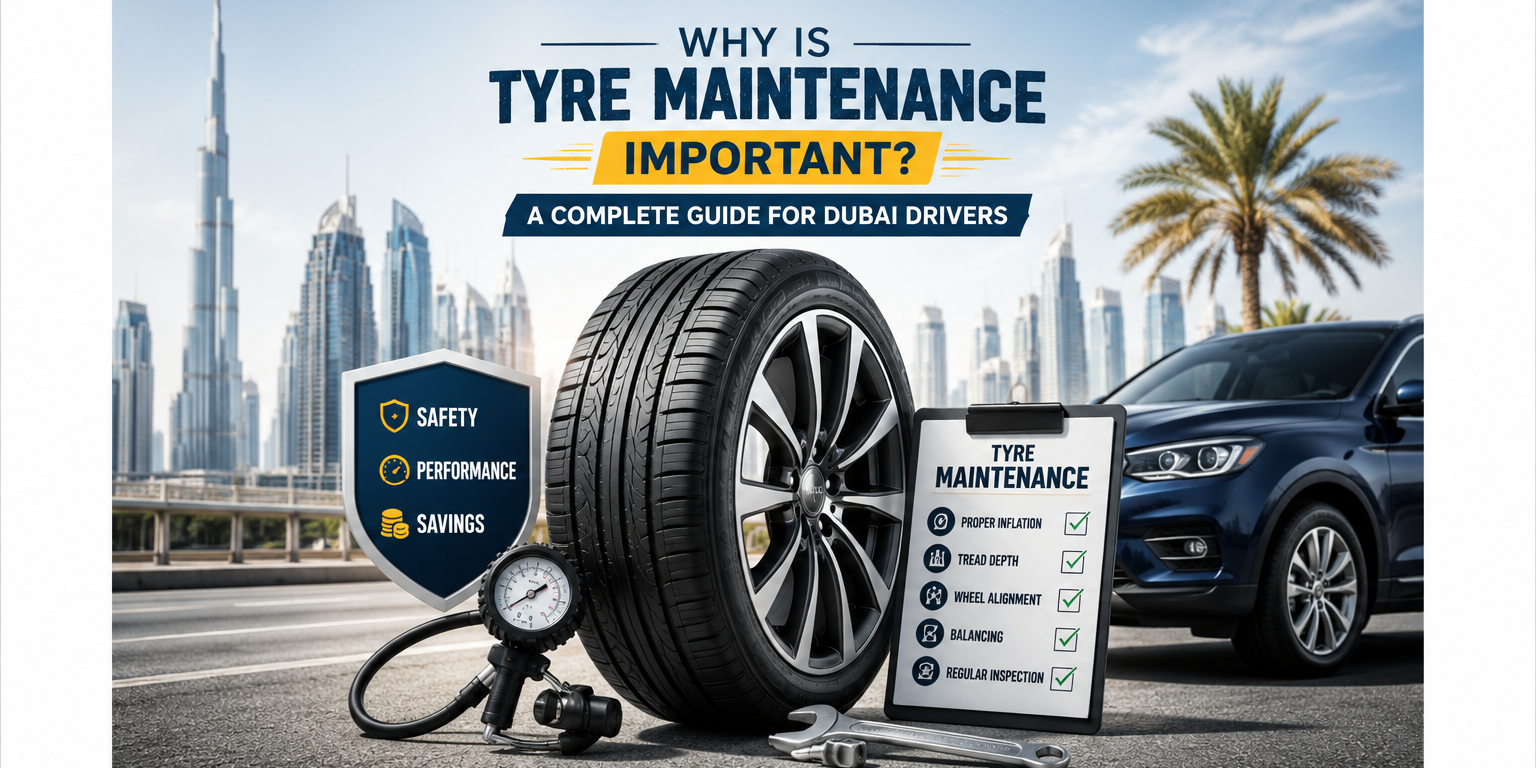
A Simple Tyre Maintenance Checklist
Good tyre care does not require expensive tools or deep mechanical knowledge. A short routine, done consistently, makes the biggest difference.
- Check tyre pressure monthly, using the recommended PSI listed on the sticker inside your driver’s door, not just the number printed on the tyre itself.
- Inspect tread depth using a simple tread gauge or the coin test, checking multiple points around each tyre.
- Look for visible damage, including cracks, cuts, bulges, or embedded objects like nails or screws.
- Rotate your tyres every 8,000 to 10,000 km so wear spreads evenly across all four, extending overall lifespan.
- Get wheel alignment checked if you notice pulling, vibration, or after hitting a pothole or curb.
- Balance your tyres during rotation or whenever you feel vibration through the steering wheel.
- Replace tyres proactively, ideally before tread wears too thin, rather than waiting for a failure to force the decision.
Building this into your regular car care routine, alongside oil changes and service intervals, keeps tyre problems from sneaking up on you.
How Dubai’s Heat and Roads Affect Tyre Life
Extreme heat is the single biggest factor shortening tyre life in the UAE. When rubber compounds are exposed to sustained high temperatures, they degrade faster, becoming more brittle and prone to cracking. This is why a tyre rated to last 60,000 km in a cooler climate might realistically need replacing closer to 40,000 to 45,000 km here.
Long highway stretches at consistent high speeds also generate more internal tyre heat than stop-start city driving. If you regularly drive between emirates, or take weekend trips into the desert, your tyres are working harder than the average commuter’s. That extra strain makes routine checks even more important, not less.
Sand and dust exposure adds another layer. Fine sand can work its way into wheel wells and valve stems over time, and off-road or desert driving puts additional stress on tyre sidewalls that standard city tyres are not always built to handle well.
The Real Benefits of Staying on Top of Tyre Maintenance
Consistent tyre care pays off in ways that go beyond just avoiding breakdowns.
- Better fuel economy. Properly inflated tyres reduce rolling resistance, which can improve fuel efficiency by a noticeable margin over months of driving.
- Longer tyre lifespan. Regular rotation and alignment checks help tyres wear evenly, meaning you replace them less often.
- Improved safety. Good tread and correct pressure directly improve braking distance and handling, especially during Dubai’s occasional but intense rain.
- Lower long-term costs. Catching small issues early, like a slow leak or minor misalignment, is far cheaper than dealing with a blowout or premature replacement.
- Smoother, quieter rides. Balanced, well-maintained tyres reduce vibration and road noise, making daily drives more comfortable.
These benefits compound over time. A car with consistently well-maintained tyres tends to have lower overall running costs and fewer unexpected repair bills.
Common Mistakes Dubai Drivers Make With Tyres
A few habits show up again and again, and they are worth calling out directly.
Many drivers only check tyre pressure when a warning light appears on the dashboard, rather than proactively each month. By the time that light triggers, pressure has often already dropped significantly. Others assume that because a tyre “looks fine” visually, it does not need a professional inspection, even though internal damage or slow leaks are not always visible to the eye.
Another common mistake is ignoring tyre age. Even tyres with decent tread can become unsafe after five to six years due to rubber breakdown from heat exposure, regardless of how many kilometres they have covered. Checking the manufacture date, found on the tyre’s sidewall, is just as important as checking tread depth.
When to Repair and When to Replace
Not every tyre issue means buying a full new set. Small punctures in the tread area, away from the sidewall, can often be safely repaired by a professional. However, sidewall damage, deep cuts, bulges, or tyres with tread below the safe minimum should always be replaced rather than patched.
If you are ever unsure whether a tyre needs repair or replacement, it is worth getting a professional opinion rather than guessing. A quick inspection is inexpensive compared to the risk of driving on a compromised tyre.
Where Professional Tyre Care Fits In
Doing basic checks yourself, like monthly pressure monitoring and visual inspections, goes a long way. But some things genuinely benefit from professional tools and expertise, particularly wheel alignment, precision balancing, and identifying internal damage that is not visible from the outside.
This is where a trusted tyre service center becomes useful, not as a replacement for your own awareness, but as a partner in keeping your car genuinely road ready. At Car Garage Auto Services, our team checks pressure, tread, alignment, and balance in one visit, often while you wait, and flags issues before they become expensive or dangerous. If you are due for a check, or simply unsure of your tyres’ current condition, booking a quick inspection with Car Garage Auto Services is a small step that protects both your safety and your budget.
Key Takeaways
Tyre maintenance is not a minor detail buried in your car’s manual. In Dubai’s heat and high-speed road environment, it directly affects your safety, your fuel costs, and how often you need to replace expensive components. A simple monthly habit of checking pressure and tread, combined with periodic professional inspections, prevents the vast majority of tyre-related breakdowns and accidents.
Your tyres are the only part of your car actually touching the road. Treating them as a priority, not an afterthought, is one of the easiest ways to drive safer and spend less over time. If it has been a while since your last tyre check, there is no better time than now to book one with Car Garage Auto Services and get your car back to being genuinely road ready.
Frequently Asked Questions
How often should I check my tyre pressure in Dubai? Check tyre pressure at least once a month, and always before long highway drives. Dubai’s heat causes pressure to fluctuate more than in cooler climates, so monthly checks help catch issues early.
What is the safe minimum tread depth for tyres? Most regions set 1.6mm as the legal minimum tread depth, though replacing tyres before they reach this point is safer, especially in high-speed or wet driving conditions.
Why do tyres wear out faster in Dubai than in other countries? Sustained high road surface temperatures, often above 60°C in summer, accelerate rubber degradation. Combined with high-speed highway driving, this shortens tyre lifespan compared to cooler climates.
Can I repair a tyre instead of replacing it? Small tread punctures away from the sidewall can often be repaired safely by a professional. Sidewall damage, bulges, or low tread depth typically require full replacement rather than repair.
How do I know if my tyres need alignment? Signs include your car pulling to one side while driving straight, uneven tread wear, or steering wheel vibration at higher speeds. A professional alignment check can confirm and correct the issue.
SEO Meta Description: Why is tyre maintenance important in Dubai’s heat? Learn key tyre care tips, warning signs, and a simple checklist to stay safe on the road.
Image Generation Prompt: A close-up photograph of a technician’s hands checking tyre tread depth with a gauge on a car tyre, bright daylight, clean modern garage setting, realistic and professional automotive photography style, no text or logos.