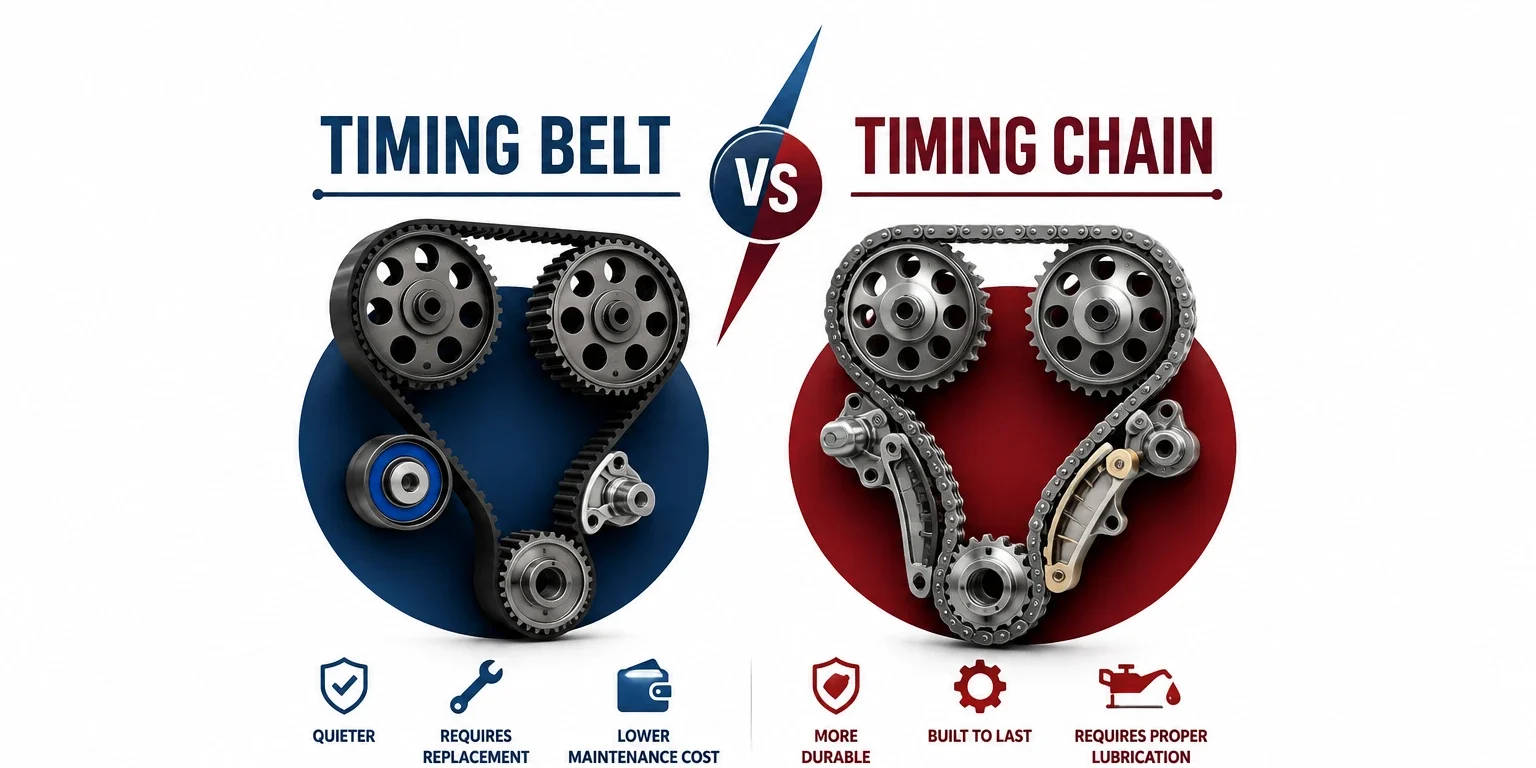
When a car engine is running smoothly, most drivers never think about what keeps the pistons and valves moving at exactly the right moment. That job belongs to the engine timing system, which usually uses either a timing belt or a timing chain. But when it comes to timing belt vs timing chain, which one is better, how long do they last, and what happens when they fail? This guide explains the differences in practical terms, including warning signs, maintenance, replacement costs, and what an experienced mechanic looks for during an inspection.
What Is an Engine Timing System?
The engine timing system keeps the crankshaft and camshaft synchronized so the engine valves open and close at the correct time in relation to the movement of the pistons.
The crankshaft controls piston movement, while the camshaft controls the engine valves. The timing belt or chain connects these moving parts and maintains their relationship. If that synchronization is lost, the engine may run badly or stop completely. In some engines, incorrect timing can cause pistons and valves to collide, resulting in serious internal damage.
This is why a timing component is much more important than an ordinary belt or chain. It is effectively part of the engine’s coordination system.
Timing Belt vs Timing Chain: What Is the Difference?
The main difference is the material and construction. A timing belt is a reinforced toothed rubber belt that runs around timing sprockets, while a timing chain is a metal chain that performs the same synchronization job.
Both systems have the same basic purpose, but their maintenance requirements, operating characteristics, lifespan, and failure patterns can be different.
| Feature | Timing Belt | Timing Chain |
|---|---|---|
| Construction | Reinforced rubber | Metal chain |
| Lubrication | Normally operates without engine oil | Requires engine oil |
| Noise | Generally quieter | Can produce more mechanical noise |
| Replacement | Usually replaced at a scheduled interval | Often replaced when worn or when symptoms appear |
| Typical warning before failure | May provide limited warning | Often produces rattling or timing-related symptoms |
| Related components | Tensioners, idlers, pulleys, sometimes water pump | Guides, tensioners and sprockets |
| Failure risk | Can fail suddenly if overdue or damaged | Can stretch or develop guide/tensioner problems |
| Service approach | Follow manufacturer interval | Monitor condition and maintain correct oil service |
The exact design varies between engines, so the vehicle manufacturer’s service schedule should always take priority.
What Is a Timing Belt?
A timing belt is a toothed belt designed to synchronize the crankshaft and camshaft. Its teeth engage with timing sprockets so the belt can maintain precise engine timing.
Modern timing belts are made from reinforced materials designed to withstand heat, flexing, and continuous operation. Gates notes that automotive timing belts are engineered for resistance to heat, contamination and wear.
One advantage is that a timing belt normally operates without engine oil. It is also generally quieter than a metal timing chain.
However, the belt is still a wear component. Age, mileage, heat, oil contamination, incorrect tension and worn related components can shorten its service life.
What Is a Timing Chain?
A timing chain is a metal chain that connects the crankshaft and camshaft, keeping the upper and lower sections of the engine synchronized.
Unlike a conventional timing belt, the chain operates inside the engine and relies on engine oil for lubrication. It works with components such as chain guides, tensioners and sprockets.
Timing chains are known for their durability and can last a long time when the engine receives proper maintenance. However, they are not automatically lifetime components. A worn chain, weak tensioner, damaged guide or poor oil maintenance can eventually create timing problems. Haynes notes that worn chains can stretch and produce rattling noises, while severe timing problems can cause poor running or engine damage.
Timing Belt vs Timing Chain: Which Is Better?
There is no universal winner. A timing belt can be quieter, lighter and straightforward to service at a scheduled interval, while a timing chain can provide long service life and does not normally require the same type of routine replacement interval.
The better system depends on the engine’s design and how well it is maintained. A timing chain is not automatically better simply because it is made from metal, and a timing belt is not automatically inferior because it is made from rubber.
For an owner, the most important question is not “Which technology is better?” but “What does my engine manufacturer require?”
Timing Belt Lifespan vs Timing Chain Lifespan
One of the most common questions mechanics hear is, “How long will it last?”
There is no single mileage figure that applies to every vehicle. The timing belt replacement interval is determined by the vehicle and engine manufacturer. Gates also advises that timing belts should be replaced according to the specified interval from the belt manufacturer or original equipment manufacturer.
Timing chains generally do not follow the same universal scheduled replacement pattern. Their service life depends heavily on oil quality, oil level, driving conditions, tensioner condition, chain guides and overall engine maintenance.
Timing Belt Lifespan
A timing belt may need replacement based on a combination of:
- Mileage
- Age
- Manufacturer recommendations
- Heat exposure
- Oil or coolant contamination
- Belt condition
- Tensioner and pulley condition
Even if the car appears to run normally, an overdue belt should not be ignored.
Timing Chain Lifespan
A timing chain can last for many years, but that does not mean it should be forgotten.
Poor oil maintenance is particularly important because the chain, guides and hydraulic tensioner depend on proper lubrication and oil pressure. A vehicle with neglected oil changes may develop timing chain problems much earlier than a well-maintained vehicle.
Timing Belt Failure Symptoms
A timing belt does not always give the driver an obvious warning before failure. That is one reason scheduled replacement is so important.
Possible warning signs include:
- Engine misfiring
- Difficult starting
- Rough engine operation
- Unusual ticking or abnormal belt area noises
- Loss of engine power
- Visible belt damage during inspection
- Oil contamination around the timing area
However, these symptoms can have several causes. A mechanic should diagnose the vehicle rather than assuming every unusual noise means the timing belt is failing.
A broken timing belt can stop the camshaft from maintaining valve timing. On an interference engine, this can allow pistons and valves to collide and cause major internal damage.
Timing Chain Failure Symptoms
Timing chain problems often develop differently.
Common symptoms can include:
- Rattling noise, particularly during startup
- Rough idle
- Engine misfires
- Poor acceleration
- Difficulty starting
- Check engine warning
- Timing-related fault codes
- Reduced engine performance
A timing chain rattling noise should not be ignored, especially if it is strongest during cold starts.
A worn chain may develop excessive slack, while a failing tensioner or guide can make the situation worse. Haynes specifically identifies rattling and changes in engine operation as possible signs of chain wear.
Why Does a Timing Chain Make a Rattling Noise?
A timing chain may rattle when there is excessive slack or when the chain tensioner cannot maintain the required tension.
For example, a driver may report a short metallic rattle immediately after starting the engine. A technician would not replace the chain based on that sound alone. They would check oil condition, oil level, tensioner operation, guides, timing correlation and diagnostic codes before deciding what actually needs repair.
That diagnostic approach matters because a noisy timing chain is not necessarily the same problem as a worn chain.
Can a Timing Belt Make Noise?
Yes, but the source of a timing belt noise may not be the belt itself.
A worn tensioner, idler pulley, bearing or water pump can create unusual sounds from the timing area. Gates recommends treating the timing system as a complete system, including components such as the belt, pulleys, tensioners and, where applicable, the water pump.
This is an important practical lesson: replacing only the belt while leaving a damaged tensioner in place can create another problem soon after the repair.
Timing Belt Maintenance: What Should You Do?
The safest approach is preventive maintenance rather than waiting for failure.
If your vehicle uses a timing belt:
- Check the manufacturer’s replacement interval.
- Replace the belt at the recommended mileage or age.
- Inspect tensioners and idler pulleys.
- Check for oil or coolant contamination.
- Inspect the water pump if it is driven by the timing system.
- Use parts that meet the vehicle manufacturer’s specifications.
A complete timing system repair can make more sense than replacing one component at a time. Gates specifically recommends replacing timing belts, pulleys and tensioners together, with the water pump included where appropriate.
Timing Chain Maintenance: What Should You Do?
Timing chain maintenance starts with something that seems simple: use the correct engine oil and maintain the correct oil service schedule.
Oil that is old, contaminated or at the wrong level can affect components inside the timing system. The chain tensioner and other components depend on proper lubrication.
If your vehicle develops a chain rattle, rough running or timing-related fault codes, have the engine inspected rather than continuing to drive until the chain fails.
Timing Belt or Timing Chain: How Can You Tell Which One Your Car Has?
You usually cannot determine it reliably by looking at the engine from above.
Some timing systems are hidden behind covers, and engine designs differ even within the same vehicle model. The most reliable ways to identify the system are:
- Check the vehicle owner’s manual.
- Check the manufacturer’s technical information.
- Ask a qualified technician.
- Provide the vehicle’s exact make, model, engine and model year when ordering parts.
Don’t assume that every model in a particular vehicle range uses the same system. Engine variants can use different timing designs.
Interference Engine vs Non-Interference Engine
This distinction becomes particularly important when discussing timing belt failure.
An interference engine is designed with limited clearance between the pistons and valves. If the timing system loses synchronization, the piston and valve can potentially contact each other.
A non-interference engine has enough clearance that the piston and valves generally do not collide when normal timing is lost.
This does not mean a timing belt failure is harmless on a non-interference engine. The vehicle can still stop running and require a tow and repair. But the likelihood of severe internal valve damage can be different.
Because engine designs vary, never assume your engine is non-interference without confirming its exact specification.
Timing Belt Replacement vs Timing Chain Replacement
The repair process can be very different.
A timing belt replacement commonly involves removing covers and replacing the belt, tensioner and related components. Depending on the engine design, the water pump may also be part of the recommended service.
Timing chain replacement can involve considerably more labor because the chain is located inside the engine. Depending on the design, a repair may involve the chain, guides, tensioner and sprockets, followed by careful timing alignment.
The final cost depends on the vehicle, engine design, parts required and labor time.
Timing Belt Replacement Cost vs Timing Chain Replacement Cost
There is no reliable single price for either repair.
A timing belt replacement cost depends on the vehicle, accessibility, parts kit and whether related components such as the water pump and tensioners are replaced.
A timing chain replacement cost can be higher when the engine requires extensive disassembly to access the chain.
This is why comparing two quotes based only on the headline price can be misleading. One workshop may quote only the belt, while another may quote a complete timing system service with tensioners, pulleys and a water pump.
Before approving the repair, ask exactly what the quote includes.
A Real-World Example: Why a Small Timing Noise Matters
Consider a common workshop scenario.
A customer brings in a car because it produces a brief rattling noise when starting from cold. The engine still runs, so the driver assumes it is probably an accessory belt.
A technician checks the oil level and condition, listens to the timing area, scans for fault codes and checks camshaft and crankshaft synchronization. The inspection reveals excessive timing chain movement and a tensioner problem.
Catching the issue at this stage can be dramatically better than waiting for the chain to jump timing. Once engine timing is lost, the vehicle may run poorly or stop, and an interference engine can suffer internal damage.
The lesson is simple: a strange timing-related noise is cheaper to investigate than to ignore.
Common Timing System Mistakes Car Owners Make
Several mistakes appear repeatedly in real workshop situations.
Waiting for a Timing Belt to Break
This is one of the worst strategies. A timing belt is a scheduled maintenance component on many engines. Waiting for failure can turn a planned maintenance expense into an engine repair.
Assuming a Timing Chain Never Needs Attention
“Lifetime chain” does not mean “immune to wear.” Oil condition, tensioners, guides and chain stretch still matter.
Replacing Only the Belt
If the tensioner or idler is already worn, installing a new belt without addressing the underlying problem can lead to premature failure. Gates recommends complete timing system maintenance rather than treating the belt as an isolated component.
Ignoring Engine Oil
For engines with timing chains, oil maintenance is especially important. Using the correct specification and maintaining the recommended service interval helps protect the timing system.
Guessing From a Noise
A rattle, squeal or ticking sound does not automatically identify the failed component. Proper diagnosis is essential.
When Should You Visit a Mechanic?
Get the vehicle inspected if you notice:
- New rattling from the engine
- Difficult starting
- Repeated misfires
- Rough idle
- Loss of power
- Check engine warning
- Unusual timing area noises
- An overdue timing belt service
- Unknown maintenance history on a recently purchased used car
If you have recently purchased a used vehicle and cannot confirm when the timing belt was replaced, checking the service history is important. If the replacement history cannot be verified, a professional inspection can help determine the appropriate next step.
How Car Garage Auto Services Can Help
Timing system problems require more than simply swapping a belt or chain. Correct diagnosis, quality replacement components and accurate engine timing are all important.
At Car Garage Auto Services, technicians can inspect timing-related symptoms, identify potential belt or chain problems and recommend the appropriate repair based on the vehicle’s engine design and condition.
If you are dealing with unusual engine noise, an overdue timing belt replacement, timing chain symptoms or uncertainty about your vehicle’s maintenance requirements, you can learn more about the available automotive services through Car Garage Auto Services.
The goal should always be to identify the actual problem before replacing expensive parts.
Final Verdict: Timing Belt vs Timing Chain
So, timing belt vs timing chain, which is better?
Neither system wins in every situation. Timing belts can offer quiet operation and predictable scheduled maintenance, while timing chains can provide long service life when properly lubricated and maintained.
The important point is that both systems are critical to camshaft and crankshaft synchronization. A neglected timing belt can break, while a neglected timing chain can stretch, rattle or develop tensioner and guide problems.
Follow the manufacturer’s service schedule, use the correct engine oil, investigate unusual noises early and replace related timing components when recommended. A small maintenance job today can prevent a very large engine repair tomorrow.
Key Takeaways
- A timing belt and timing chain perform the same basic synchronization job.
- Timing belts are generally replaced according to a manufacturer-specified interval.
- Timing chains can last a long time but still wear and require inspection.
- Timing chain rattling can indicate chain, guide or tensioner problems.
- A broken timing belt can cause severe damage on some interference engines.
- Timing system repairs should consider related components, not just the belt or chain.
- The correct maintenance schedule depends on the exact vehicle and engine.
Frequently Asked Questions
Is a timing belt better than a timing chain?
Neither is universally better. Timing belts are generally quieter and have predictable replacement intervals, while timing chains can provide long service life when properly lubricated and maintained. The best system depends on the engine’s design and maintenance requirements.
How often should a timing belt be replaced?
The timing belt replacement interval varies by vehicle and engine. Always follow the manufacturer’s specified mileage and age interval rather than relying on a universal number. If the service history is unknown, have the vehicle inspected and check the manufacturer’s recommendations.
How do I know if my timing chain is failing?
Common warning signs include rattling noises, rough running, difficult starting, misfires, reduced performance and timing-related fault codes. A technician should diagnose these symptoms because similar problems can come from other engine components.
Is timing chain replacement more expensive than timing belt replacement?
It can be, but there is no fixed rule. Timing chain repairs can require significant engine disassembly depending on the vehicle, while timing belt replacement can also become expensive when tensioners, pulleys and the water pump are included.
Can a timing belt break without warning?
Yes. A timing belt can fail without giving the driver a clear warning, which is why manufacturer-recommended replacement intervals are important. A worn tensioner, contamination or other timing system problems can also contribute to premature failure.