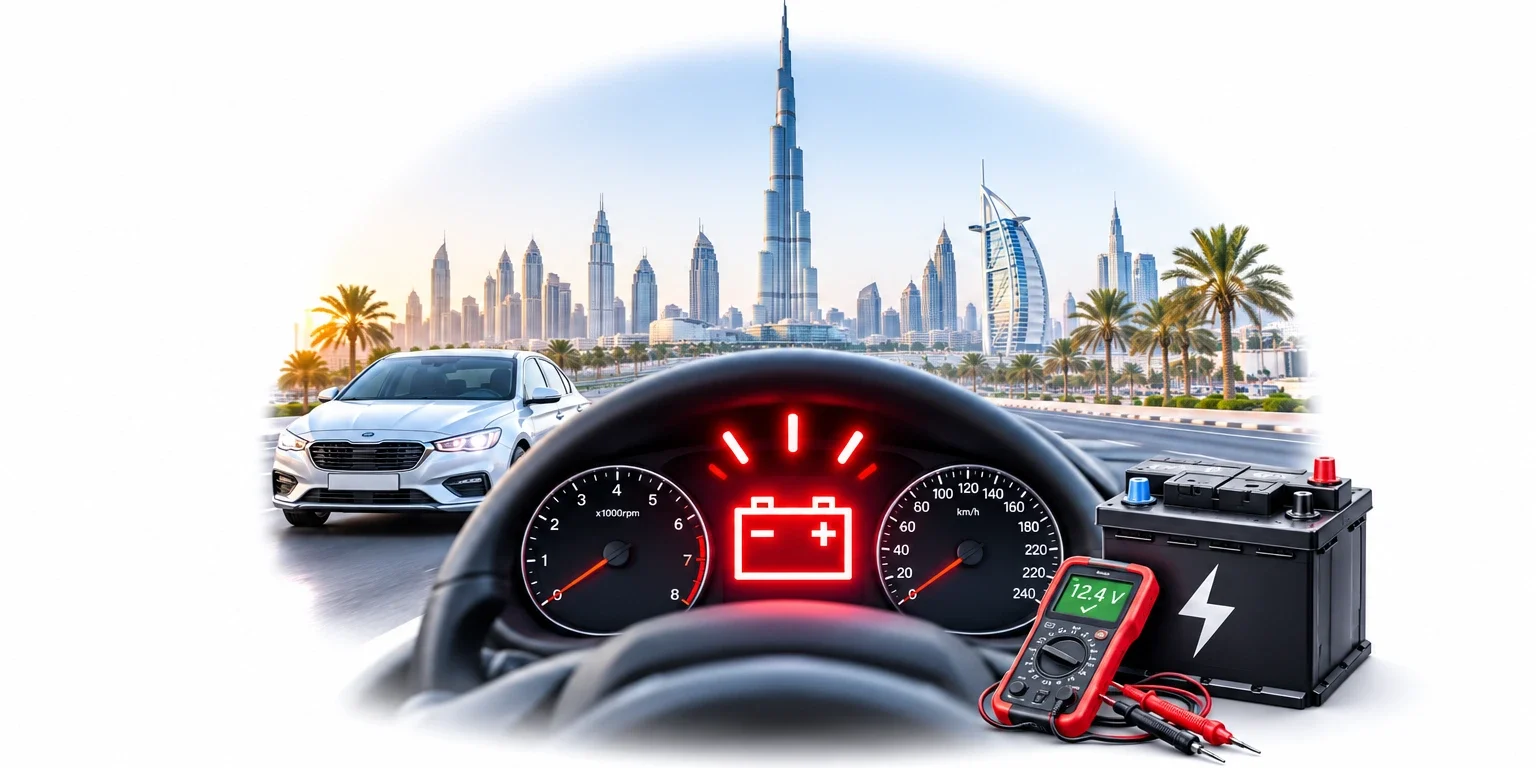
You are driving through Dubai when a red battery symbol suddenly appears on the dashboard. The first thought is usually, “My battery is dying.” But when the battery light comes on while driving, the real problem is often somewhere in the vehicle’s charging system, especially the alternator, drive belt, wiring, or voltage regulator. This guide explains what the warning means, what you should do immediately, and when you need professional car electrical repair in Dubai.
What Does It Mean When the Battery Light Comes On While Driving?
The battery warning light usually indicates a charging system problem, not simply a bad battery.
When the engine is running, the alternator supplies electrical power to the vehicle and recharges the battery. If the alternator stops producing enough voltage, or something interrupts the charging circuit, the battery warning light can appear. The car may continue running temporarily using the energy stored in the battery, but that reserve is limited.
In practical terms, your car is telling you:
“I am running, but my charging system may no longer be supplying enough electrical power.”
That is why ignoring this warning can turn a relatively simple repair into a roadside breakdown.
Why Does the Battery Light Come On While Driving?
Several problems can trigger the warning. A professional technician should test the complete charging system rather than immediately replacing the battery.
1. Failing Alternator
The alternator is one of the first components a technician will check.
Its job is to generate electrical power while the engine is running and keep the battery charged. If the alternator has a worn internal component, faulty regulator, damaged diode, or another electrical fault, its output can fall below the required level.
You may notice the battery warning light together with:
- Dim or flickering headlights
- Electrical warning messages
- Slow power windows
- Dashboard flickering
- Weak electrical accessories
- Difficulty restarting the vehicle
A failing alternator can eventually leave the vehicle running only from stored battery power.
2. Damaged or Slipping Serpentine Belt
The alternator needs mechanical power from the engine. On many vehicles, this comes through the serpentine or auxiliary belt.
If the belt becomes loose, slips, breaks, or the tensioner fails, the alternator may stop charging correctly.
This can also create other problems because the same belt may drive additional components depending on the vehicle design. A broken belt can therefore be more serious than a simple battery problem.
If you hear squealing from the engine bay, see belt damage, or notice overheating or unusually heavy steering together with the battery light, stop driving as soon as it is safe.
3. Weak or Failed Battery
Although the battery warning light is primarily associated with the charging system, the battery itself can still be part of the problem.
A battery that has reached the end of its service life may struggle to hold a charge. Dubai’s extreme heat can also accelerate battery deterioration, particularly when a vehicle spends long periods parked outside.
However, simply installing a new battery without testing the alternator can leave the original problem unresolved.
4. Loose or Corroded Battery Connections
A battery can be perfectly healthy while its electrical connection is poor.
Loose terminals, corrosion, damaged cables, or a poor ground connection can create resistance in the charging circuit. This may cause starting problems, intermittent warning lights, or unstable electrical performance.
A technician should inspect the positive terminal, negative terminal, ground connections, charging cables, and relevant electrical connections before recommending expensive parts.
5. Faulty Voltage Regulator
Modern charging systems carefully control voltage. The voltage regulator helps prevent the battery from being undercharged or overcharged.
If it fails, the vehicle may experience abnormal charging voltage and trigger the battery warning light.
On some vehicles, the regulator is integrated into the alternator, while others use different charging system designs. This is one reason vehicle specific diagnostics matter.
6. Wiring, Fuse, or Sensor Problems
Modern cars contain more electronic systems than older vehicles. A charging problem may involve wiring, a fuse, a battery monitoring sensor, or communication between the charging system and the vehicle’s control modules.
This is particularly important on European and luxury vehicles where replacing parts without proper diagnosis can become expensive very quickly.
What Should You Do If the Battery Light Comes On While Driving?
If the warning appears while you are driving, do not panic. Your priority should be getting yourself and the vehicle to a safe location.
Follow these steps:
- Reduce unnecessary electrical load. Turn off nonessential accessories such as seat heaters, unnecessary lights, chargers, and entertainment systems where practical.
- Watch for additional warning signs. Pay attention to overheating, heavy steering, strange noises, burning smells, or multiple dashboard warnings.
- Find a safe place to stop. Do not continue a long journey simply because the vehicle is still moving.
- Avoid repeatedly switching the engine off and on. If the charging system has failed, the car may not restart after being switched off.
- Arrange professional assistance. A roadside technician or tow service can prevent you from becoming stranded in traffic.
- Have the charging system diagnosed. Do not replace the battery based only on the warning light.
The safest response depends on the vehicle and the symptoms. AAA also recommends pulling over safely and having the vehicle towed when a charging problem is suspected because an alternator failure can eventually cause the vehicle to stall.
How Long Can You Drive With the Battery Light On?
There is no reliable number of kilometres or minutes that applies to every vehicle.
If the alternator has stopped charging, the vehicle is effectively using the remaining energy in the battery. How long that lasts depends on the battery’s condition, electrical load, vehicle electronics, traffic, headlights, air conditioning, and the underlying fault.
This is especially important in Dubai.
Driving in heavy traffic with the air conditioning running can place a substantial electrical demand on the vehicle. If the charging system has already failed, continuing to drive can reduce the remaining battery reserve until the engine eventually stops.
So instead of asking, “How many kilometres can I drive?”
The better question is:
“How quickly can I get the vehicle somewhere safe and have the charging system checked?”
Why Dubai Conditions Can Make Battery and Charging Problems More Serious
Dubai’s climate puts considerable stress on vehicle batteries and electrical components.
High temperatures accelerate battery ageing, while long periods of parking in direct heat can expose the battery and engine compartment to severe thermal conditions. Stop and go traffic, extensive air conditioning use, frequent short trips, and the electrical demands of modern vehicles add further stress.
This does not mean every battery warning light in Dubai is caused by heat. It simply means local operating conditions make proper battery and charging system maintenance particularly important.
For drivers of BMW, Mercedes Benz, Range Rover, Audi, Porsche, Lexus, and other vehicles with sophisticated electrical systems, an accurate diagnosis is even more important.
Real World Dubai Case: A Warning Light That Was Not Just a Battery Problem
A recent Dubai driver reported an MG RX5 developing a battery warning light while travelling on E311. After the warning appeared, the vehicle later developed poor acceleration and eventually had to be pulled over safely. A battery was replaced, but the owner was subsequently advised that the alternator might also be damaged, and the warning returned.
The important lesson is not which particular part was ultimately responsible. The lesson is that replacing the battery does not automatically fix a charging system fault.
This is exactly why a proper diagnostic process should check the battery and alternator together rather than treating the dashboard symbol as a simple battery replacement request.
Another Common Workshop Scenario: Battery Replaced, Warning Light Returns
A common diagnostic situation is straightforward.
A customer sees the red battery symbol, visits a garage, and replaces the battery. The vehicle starts normally, so everything appears fixed.
A few days later, the same warning returns.
At that point, the technician needs to look beyond the battery. The alternator output, voltage regulator, belt condition, battery terminals, wiring, and charging system communication should be checked.
A similar BMW case reported in Dubai involved repeated battery warnings even after a battery replacement. Further inspection identified a voltage regulator problem, demonstrating why charging system diagnosis is more useful than simply replacing parts.
How Does a Garage Diagnose a Battery Warning Light?
A proper inspection should start with testing, not guessing.
At a professional garage, the technician may check:
- Battery resting voltage
- Battery health and load performance
- Alternator charging output
- Charging voltage under electrical load
- Battery terminals and cables
- Ground connections
- Serpentine belt condition
- Belt tensioner and pulleys
- Voltage regulator operation
- Relevant fuses and wiring
- Battery monitoring sensors
- Diagnostic trouble codes
The exact testing procedure varies by vehicle.
For example, a modern European vehicle may require electronic diagnostics and battery registration after replacement. Some vehicles also use intelligent charging systems that change alternator output according to operating conditions.
That is why a simple “battery test” may not tell the complete story.
Battery Light vs Check Engine Light: Are They the Same?
No.
The battery warning light generally points toward the battery charging or electrical system. The check engine light can indicate problems involving the engine, emissions system, sensors, fuel system, ignition system, or other components.
However, a charging problem can sometimes cause multiple warning lights to appear because modern vehicles depend heavily on stable electrical voltage.
If the battery light appears together with ABS, steering, engine, or other warnings, treat the situation seriously and have the vehicle inspected.
Can You Fix the Problem Yourself?
You can perform a basic visual inspection if the vehicle is safely parked and the engine is switched off.
You can look for obvious signs such as:
- A visibly damaged or missing belt
- Heavy corrosion around battery terminals
- Loose battery connections
- Burnt wiring
- Unusual smells
However, avoid experimenting with the charging system while the engine is running.
For example, disconnecting a battery terminal while the engine is running is not a suitable diagnostic method for modern vehicles. It can create electrical problems and does not replace proper charging system testing.
If the warning light remains on, professional diagnosis is the safer option.
When Should You Call a Car Garage in Dubai?
Call a professional garage or roadside assistance service promptly if:
- The battery warning light stays on.
- Headlights become noticeably dim.
- The dashboard starts flickering.
- The steering suddenly becomes heavy.
- The engine temperature begins rising.
- You smell burning rubber or electrical components.
- The vehicle starts losing electrical functions.
- The engine struggles or stalls.
- The vehicle will not restart.
If you are already experiencing several of these symptoms, continuing to drive can increase the chance of a complete breakdown.
Battery and Electrical System Repair in Dubai
At Car Garage Auto Service, battery and electrical problems are approached as charging system problems rather than automatic battery replacement jobs.
The workshop provides electrical and battery services that include battery replacement, wiring repairs, alternator and starter motor work, and electrical diagnostics. It also provides roadside assistance and towing services for situations where continuing to drive is not sensible.
For drivers who need a broader inspection, the company also provides car maintenance, vehicle inspection, car repair, and engine repair services.
You can explore the available services through the Car Garage Auto Service website and choose the service that matches your vehicle’s symptoms.
How to Prevent Battery and Charging Problems
You cannot prevent every alternator or electrical failure, but regular checks can catch warning signs earlier.
During routine servicing, ask your technician to inspect the battery condition and charging system. Battery terminals should remain clean and secure, belts should be checked for wear, and unusual electrical symptoms should not be ignored.
In Dubai, it is particularly sensible to have the battery tested before periods of extreme summer heat. If your vehicle is parked for long periods, especially outdoors, discuss appropriate battery maintenance with your technician.
Most importantly, do not wait until the vehicle refuses to start before investigating repeated battery warnings.
Frequently Asked Questions
Is it safe to drive when the battery light comes on?
It is not advisable to continue driving normally. The light can indicate that the alternator has stopped charging the battery, which means the vehicle may eventually lose electrical power and stall. Move to a safe location and arrange professional inspection as soon as possible.
Does the battery light mean I need a new battery?
Not necessarily. The warning usually indicates a charging system problem. The alternator, drive belt, voltage regulator, wiring, battery connections, sensors, or battery itself may be responsible. Testing the complete system is the best way to identify the actual fault.
How long can I drive after the battery light comes on?
There is no guaranteed driving time. If the alternator has stopped charging, the car is using the remaining energy in the battery. Electrical demand and battery condition determine how long the vehicle continues running. It is safer to stop and arrange assistance rather than relying on a specific distance estimate.
Why does my battery light come on and then disappear?
An intermittent battery warning can occur when charging voltage fluctuates. Possible causes include a slipping belt, failing alternator, poor electrical connection, voltage regulator problem, or another charging system fault. Intermittent does not necessarily mean harmless.
What should I check if the battery light stays on after replacing the battery?
Have the alternator output, voltage regulator, belt, terminals, wiring, battery sensor, and charging system control functions tested. A new battery will not correct an alternator or charging circuit problem.
Final Thoughts
When the battery light comes on while driving, do not automatically assume the battery is the culprit. The warning is better understood as a signal that something may be wrong with the vehicle’s charging system.
The alternator, belt, battery, terminals, voltage regulator, wiring, and sensors can all play a role. In Dubai’s demanding climate, ignoring the warning can turn a manageable repair into an inconvenient roadside breakdown.
If the warning appears, reduce unnecessary electrical load, move somewhere safe, and arrange a professional inspection. A proper diagnosis can identify the real cause before you spend money replacing parts that were never the problem.
For battery, alternator, electrical, diagnostic, and general vehicle repair services in Dubai, visit Car Garage Auto Service to explore the available services and arrange professional assistance.