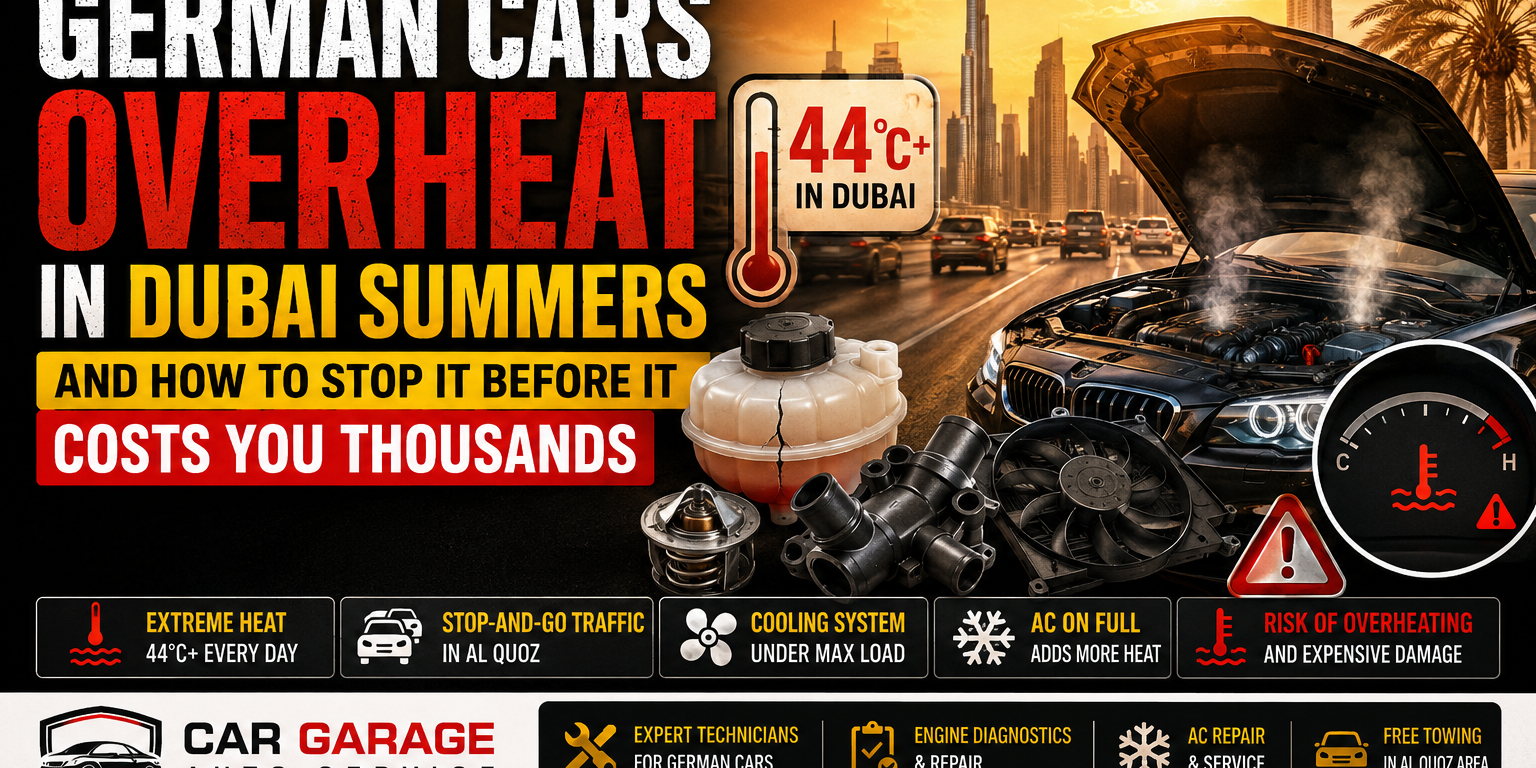
You are sitting in traffic near Al Quoz on a July afternoon. The outside temperature reads 44°C. Your BMW’s dashboard suddenly lights up with a temperature warning. Your stomach drops. You pull over, not sure what to do next, while other cars inch past you.
This situation plays out dozens of times every summer across Dubai. And the frustrating part is that the same car behaved perfectly fine during winter. So what changed? The answer is not a manufacturing defect or bad luck. It is a genuine mismatch between how German cars are engineered and what Dubai summers actually demand from them.
This guide explains that mismatch clearly, covers the exact components that fail and why, shares warning signs that most drivers miss, and tells you exactly what to do before the summer peaks. If you own a BMW, Mercedes-Benz, Audi, or Volkswagen in Dubai, read this before the temperature climbs any further.
Dubai Summers Are Not Normal Heat. They Are Extreme.
To understand why German cars struggle here, you first need to appreciate the scale of Dubai’s summer conditions. According to the UAE National Centre of Meteorology via Gulf News, peak temperatures during July and August regularly reach between 44°C and 48°C across coastal and inland areas, with recorded highs touching 51.2°C. Bloomberg reported that on a single day in July 2024, the heat index in Dubai made conditions feel like over 62°C when humidity was factored in.
German cars, on the other hand, are engineered and tested in Central European conditions where summer temperatures rarely exceed 30°C to 35°C. That is not a gap of a few degrees. It is a completely different thermal world. The cooling systems, thermostat calibrations, plastic components, and fan thresholds are all designed around those European baseline temperatures. When you operate those same systems in Dubai from May to September, they are pushed well beyond the operating envelope they were built for.
This is the root cause of the problem. Everything else flows from this mismatch.
The Exact Reason German Cars Use Components That Cannot Handle This Heat
This point surprises most car owners, so it is worth explaining clearly.
German automakers like BMW, Mercedes-Benz, and Audi made a deliberate engineering choice to use plastic and polymer composites in critical cooling system components instead of metal. According to BimmerFix’s comprehensive BMW cooling system guide, these parts include the radiator end tanks, coolant expansion tanks, thermostat housings, and in many models, the water pump impeller itself.
The reason for this choice was not cost-cutting. It was weight reduction and manufacturing efficiency, both of which improve fuel economy and performance metrics. In moderate European climates, these plastic components are perfectly adequate and can last well over 100,000 miles.
In Dubai, the math changes dramatically. Every time your engine heats up and cools down, those plastic components expand and contract. In Dubai, that happens in extreme temperature swings every single day from May to September. European vehicle specialists working in hot climates report that these components begin showing micro-fractures and structural degradation significantly earlier than in cooler environments. UV exposure from Dubai’s intense direct sun accelerates this process further, weakening the material from the outside while heat cycles attack it from within.
The result is a component that looks completely normal from the outside but is structurally compromised. As Southside Euro’s coolant leak analysis explains, a slow seep from a cracked expansion tank or a split radiator end cap does not always produce a visible puddle under the car. The coolant level drops quietly, and the first sign the driver notices is a temperature gauge climbing higher than usual on a hot afternoon.
Why the Thermostat Becomes a Hidden Enemy in Dubai
The thermostat is a small valve that controls when coolant flows from the engine to the radiator. When the engine is cold, the thermostat stays closed to help it warm up faster. Once it reaches operating temperature, the thermostat opens to allow coolant circulation and heat dissipation.
Here is the specific problem with many German vehicle thermostats in Dubai conditions. BMW and Mercedes engines are designed to run at relatively high operating temperatures for efficiency and emissions compliance. Their thermostats are calibrated to open later, meaning the engine temperature is allowed to build longer before cooling begins. In cool European traffic, this is fine. In Dubai traffic at 44°C ambient, the engine is already starting from a higher baseline, and a thermostat that opens late gives heat very little room to build before crossing into dangerous territory.
Worse, thermostats in German vehicles are known to stick in the closed position under sustained heat stress. When a thermostat sticks closed, coolant circulation stops entirely. The engine temperature then rises rapidly and without warning. Angelo’s Performance notes that this, combined with the plastic component vulnerabilities, makes BMW and Mercedes cooling systems particularly unpredictable in extreme heat environments. This is one of the leading causes of roadside breakdowns on Dubai’s highways during summer.
The thermostat is a relatively inexpensive part. Replacing it preventively before summer is a straightforward job. Replacing a warped cylinder head because the thermostat failed unexpectedly is a very different conversation.
The Air Conditioning Factor Most Drivers Do Not Think About
In Dubai, running the air conditioning from May to September is not a choice. It is a necessity. What most drivers do not realize is the direct mechanical relationship between AC usage and engine cooling load.
When the air conditioning system is active, the AC compressor draws power directly from the engine. This creates additional heat load. That heat has to go somewhere, and it goes to the cooling system. At the same time, the AC condenser sits physically in front of the radiator. The condenser releases its own heat into the air before that air reaches the radiator. On a 44°C day, the air reaching your radiator has already absorbed heat from both the environment and the condenser. The radiator is trying to cool engine coolant using air that is already very hot.
This combination pushes the cooling system to its absolute limit. A car with a slightly underperforming cooling system, perhaps a cooling fan with a weak motor or coolant that is two years past its service interval, may cope fine in mild weather. Add a full afternoon of AC running in stop-and-go Al Quoz traffic, and that same marginal system tips over the edge.
Stop-and-Go Traffic in Al Quoz Makes Everything Worse
There is a reason so many overheating incidents in Dubai happen not on the highway but in industrial area traffic, specifically around Al Quoz, Al Quoz Industrial Area 1, and the surrounding roads during midday hours.
At highway speeds, the movement of the car forces air through the radiator naturally. This ram air effect does most of the cooling work. When the car is stationary or crawling at 10 kilometers per hour, ram air disappears. The only thing keeping the engine cool is the electric cooling fan. If that fan is running at 80% efficiency instead of 100% because the motor is worn or the relay is weakening, you lose a significant amount of cooling capacity at exactly the moment you need it most.
A car sitting still with the engine running and AC on full in 44°C heat is a maximum-load scenario for every cooling component simultaneously. German vehicles with even minor deferred maintenance often cannot sustain that load for the 15 to 20 minutes it takes to crawl through a busy Al Quoz intersection at noon.
Warning Signs That Appear Before a Full Overheat
Your car almost never overheats without giving signals first. The problem is that most drivers either do not notice them or assume they are minor. Masters European and Japanese highlight that many BMW owners only realize something is wrong when steam appears from the hood, by which point damage has already begun. Here is what to watch for much earlier than that:
The temperature gauge rising above its usual midpoint position, even briefly, is the clearest early warning. Most drivers ignore a gauge that climbs slightly and then drops back down. That behavior indicates the cooling system is struggling intermittently, not that everything is fine.
A sweet, slightly syrupy smell inside or outside the cabin often means coolant is leaking onto hot engine surfaces and burning off. It smells nothing like engine oil or exhaust. If you notice it, investigate immediately.
The AC suddenly blowing warm air while the system is switched on can mean the car’s engine control unit has deliberately disabled the AC compressor to reduce load and protect the engine. This is a built-in protection mechanism that activates when temperatures get critically high.
Visible white residue or crystalline deposits near coolant hoses, around the expansion tank, or at hose connection points indicate a slow seep that has been evaporating and leaving mineral deposits behind. European cooling system specialists flag this as one of the most overlooked early signs of impending failure in BMW and Mercedes vehicles.
Any of these signs warrant an immediate workshop visit. A cooling system pressure test and inspection at this stage is a small cost compared to what comes next if you ignore it.
What Happens When Overheating Goes Unchecked
This section matters because many car owners still drive through mild overheating warnings assuming the car will recover. It often does, briefly. But every time it happens, damage accumulates.
On a BMW N54 or a Mercedes M272 engine, a single serious overheating event can warp the cylinder head. A warped head destroys the head gasket seal, allowing coolant to enter the combustion chamber and engine oil to mix with coolant. Once this happens, engine rebuild or replacement is the only path forward. Costs for this type of repair on a German vehicle in Dubai typically start at AED 5,000 and can reach AED 15,000 or more depending on the model and extent of damage.
The correct comparison is not between repair costs and doing nothing. It is between the cost of a seasonal cooling system service and the cost of an engine rebuild. That comparison makes preventive maintenance the obvious choice every time.
What You Should Do Right Now to Protect Your Car
Get a cooling system inspection before summer peaks. Have a qualified technician pressure test the entire cooling system, check coolant level and condition, inspect all hoses for softness or cracking, test the thermostat, and verify cooling fan operation at full load. At Car Garage Auto Service in Al Quoz, this type of inspection is part of a summer readiness check performed by technicians who work on BMW, Mercedes, Audi, and Volkswagen vehicles daily.
Replace coolant on a shorter interval. In Dubai conditions, coolant degrades faster than in European climates because it is under thermal stress for more operating hours per year. Servicing coolant every 18 to 24 months rather than the standard two to three year European recommendation is a sensible adjustment. Always use the manufacturer-specified coolant type for your exact model. BMW, Mercedes, and Audi each specify different coolant formulations, and using the wrong mix can accelerate corrosion inside the engine.
Take early warning signs seriously. A temperature gauge that climbs slightly during slow traffic and then recovers is telling you something. It is not normal behavior. Investigate it at the next service rather than waiting to see if it gets worse.
Park in shaded areas when possible. An engine bay that starts at 55°C before the car even moves is harder to cool than one that starts at 38°C. Covered parking, underground facilities, and shaded spots reduce the starting baseline for your cooling system and extend the life of those plastic components that UV and heat degrade over time.
Why Car Garage Auto Service Is the Right Workshop for This
German vehicles require more than a general service technician. Each brand uses different coolant specifications, different thermostat designs, different electronic water pump systems, and different diagnostic requirements. What applies to a BMW N20 engine is different from what applies to a Mercedes M274 or an Audi TFSI.
Car Garage Auto Service, located in Al Quoz Industrial Area 1, specialises in European vehicle repair and maintenance and has been serving Dubai drivers for over 22 years. The workshop carries a 5-star Google rating and a team of more than 12 certified technicians who work specifically on the brands and problems covered in this guide, including BMW, Mercedes-Benz, Audi, Volkswagen, and Porsche.
Services directly relevant to summer cooling protection include engine diagnostics and repair, car AC repair and service, car engine repair, car maintenance packages, and vehicle inspection. The workshop also offers roadside assistance and free towing within Al Quoz and surrounding areas, which matters if your car is already showing signs of overheating.
You can reach the team directly at +971 56 877 8354, send a WhatsApp message, or visit at Al Quoz Industrial Area 1, First Al Khail Street. For full service details and to book an appointment, visit cargarageautoservice.ae.
Key Takeaways
German cars are exceptional machines. Their performance and refinement are genuinely impressive. But they were designed for climates with a fraction of Dubai’s summer heat load. The plastic components in their cooling systems, the late-opening thermostats calibrated for cold European winters, the additional strain of running AC at full capacity for five months straight, and the prolonged stop-and-go conditions of Al Quoz midday traffic all combine to create a predictable and preventable problem.
The answer is not to avoid driving your German car. It is to understand the seasonal stresses it faces and address them before they escalate. A cooling system service before summer, a timely coolant change, and attention to the early warning signs your car gives you will keep your BMW or Mercedes running reliably from May through September.
Your car is worth protecting. The cost of doing it right is far less than the cost of learning this lesson the hard way on the side of a Dubai highway.
Frequently Asked Questions
Why does my German car overheat in summer but never had a problem in winter? Dubai winters keep ambient temperatures between 18°C and 26°C, which gives your cooling system substantial room to manage engine heat. In summer, ambient air temperatures regularly exceed 44°C, meaning the air entering your radiator is already hot before it even starts absorbing engine heat. Any weakness in the cooling system that goes unnoticed in winter becomes a critical failure point in summer. According to Weather Atlas Dubai climate data, peak summer months see average daily highs of 39°C to 41°C, with actual maximums pushing well beyond that.
How often should coolant be changed in a BMW or Mercedes in Dubai? In European climates, the standard interval is every two to three years. In Dubai, the cooling system is under sustained high-temperature stress for a much larger portion of the year. Changing coolant every 18 to 24 months, always using the correct manufacturer-specified formulation for your model, is a more appropriate interval for Dubai operating conditions.
What does it mean if my AC suddenly starts blowing warm air on a hot day? This is often a built-in engine protection response. When the engine management system detects temperatures approaching a critical threshold, it may disable the AC compressor to reduce load and buy the cooling system more capacity. If this happens, reduce your speed, pull out of heavy traffic if possible, and have the cooling system inspected as soon as you can. Do not ignore it and assume it will resolve on its own.
Can a cracked expansion tank cause overheating without an obvious leak? Yes. Slow seeps from cracked plastic expansion tanks or radiator end caps often evaporate before reaching the ground, especially in Dubai’s heat. The coolant level drops gradually over weeks. By the time the driver notices a warning light or high temperature reading, the system is already running significantly low. Checking coolant level monthly during summer and having the system pressure tested annually catches this before it becomes an emergency.
Is Car Garage Auto Service equipped to handle German car cooling system repairs? Yes. Car Garage Auto Service in Al Quoz Industrial Area 1 specialises in European vehicles including BMW, Mercedes-Benz, Audi, Volkswagen, and Porsche. The workshop has over 22 years of experience, a team of certified technicians, and full engine diagnostics, cooling system repair, and AC service capabilities. Call or WhatsApp +971 56 877 8354 or visit cargarageautoservice.ae to book a service.