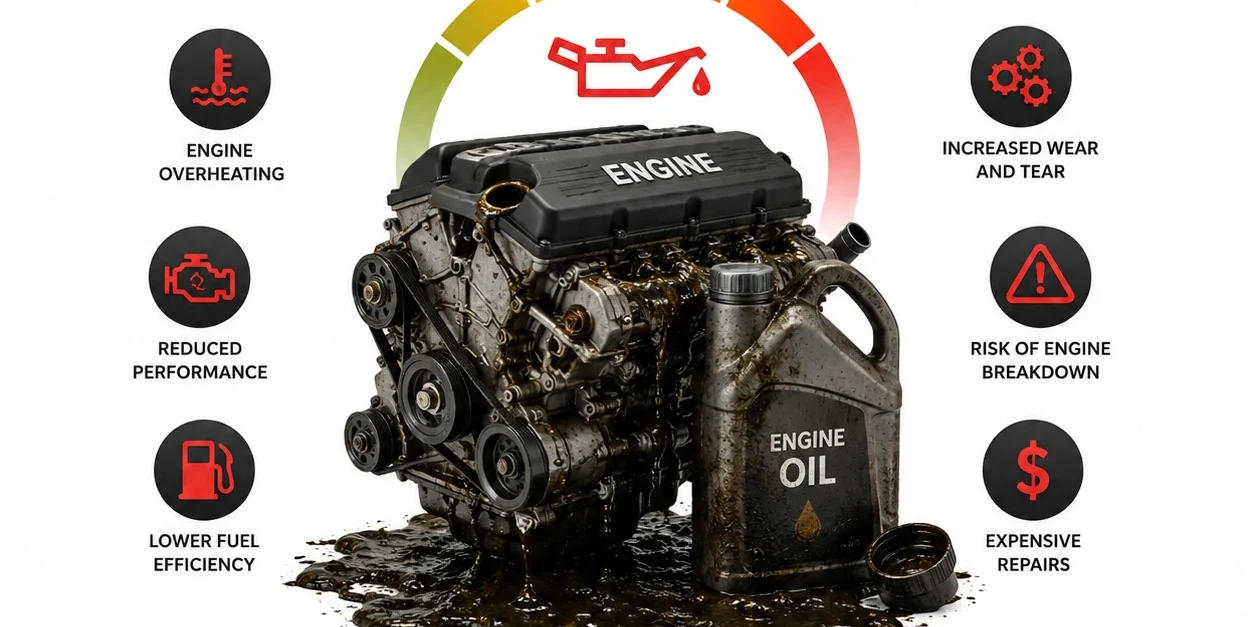
What will happen if I don’t change engine oil? At first, probably nothing dramatic. Your car may start, drive, and even feel completely normal. That is exactly why many drivers in Dubai keep postponing an oil change. The problem is that engine oil can lose its protective properties long before the driver notices a serious symptom. In this guide, we explain what happens inside an engine when oil is left too long, the warning signs to watch for, how Dubai driving conditions affect oil life, and when an oil change becomes urgent.
What Does Engine Oil Actually Do?
Engine oil is much more than a liquid that keeps engine parts slippery. It forms a protective film between moving components such as pistons, bearings, camshafts and crankshaft surfaces. It also helps carry heat away from engine components and keeps contaminants suspended so they can be removed through the oil filter.
Fresh engine oil contains additives that help control oxidation, corrosion, deposits and wear. As the oil ages, these additives are gradually consumed and the oil becomes contaminated by combustion by-products, moisture, fuel and microscopic wear particles.
Research on used engine oil confirms that oxidation, nitration, sulfation, viscosity changes and additive depletion occur as oil ages. A 2026 study examining SAE 0W-20 oil after approximately 13,000 km found measurable changes in viscosity, alkaline reserve and chemical degradation, along with detectable wear metals such as iron, copper and aluminium.
So, when you skip an oil change, you are not simply driving with “old oil.” You are asking a lubricant that has already been working hard to continue protecting an engine under heat, pressure and friction.
What Will Happen If I Don’t Change Engine Oil?
If you continue driving beyond the recommended oil-change interval, several things can happen. The exact outcome depends on the engine, oil type, mileage, driving conditions and how far the service interval has been exceeded.
The most common consequences include:
- Increased engine wear
- Poorer engine performance
- Higher operating temperatures
- Sludge and deposit formation
- Reduced fuel efficiency
- Increased risk of oil-pressure problems
- Expensive internal engine repairs
- In severe cases, complete engine failure
The important point is that engine damage usually develops gradually. You may not hear a loud noise on the first day your oil becomes overdue. The damage can build quietly until a component finally reaches its limit.
1. Engine Wear Starts to Increase
One of the main jobs of engine oil is to keep moving metal components separated by a lubricating film.
As oil degrades, its ability to perform under demanding conditions can change. Contaminants and chemical degradation can also affect lubrication and anti-wear protection.
A study published in Scientific Reports examined engine oils used in city buses beyond their recommended service interval. Researchers found degradation of anti-wear additives and changes in tribological performance as the oil was used beyond the recommended interval.
Another experimental study found that contamination in motor oil can increase friction and wear because particles interfere with the lubricating surfaces.
From a mechanic’s point of view, this is why delaying an oil change is rarely a smart money-saving strategy. You save the cost of one service today while increasing the possibility of paying for worn engine components later.
What parts can suffer?
Depending on the engine and severity of the problem, excessive wear can affect:
- Main and connecting-rod bearings
- Camshafts and camshaft bearings
- Timing components
- Piston rings
- Cylinder walls
- Turbocharger bearings
- Valve-train components
Turbocharged engines deserve particular attention because the turbocharger operates at very high speeds and temperatures. It depends heavily on proper oil flow and lubrication.
2. Your Engine Can Run Hotter
Engine oil also helps transfer heat away from internal components.
When oil becomes heavily degraded or contaminated, its ability to perform its normal lubrication and heat-management functions can be affected. Excessive friction can also contribute to additional heat generation.
This does not mean every overdue oil change will immediately cause an overheating engine. Cooling-system faults, coolant level, radiator condition, thermostat operation and other factors are also important.
However, old oil removes one important layer of protection from an engine that is already dealing with high temperatures.
This matters even more in Dubai.
During summer, vehicles can face extremely high ambient temperatures, heavy traffic, long periods of idling and frequent stop-and-go driving. These conditions can put additional thermal stress on the engine and lubricant.
That is why following the vehicle manufacturer’s maintenance schedule is particularly important for Dubai drivers.
3. Sludge and Deposits Can Build Up
Engine oil collects contaminants during normal operation. The oil filter captures many of the particles, while detergents and dispersants in the oil help manage deposits.
But oil does not have an unlimited service life.
As oil ages and oxidizes, deposits can form. Severe degradation and contamination can contribute to sludge, especially when an engine has poor maintenance, excessive heat, moisture contamination or extended oil-change intervals.
Sludge is not simply dirty oil. It can become a thick deposit that restricts oil flow and interferes with lubrication.
Once oil passages become restricted, critical components may not receive the amount of oil they need.
That is when a relatively inexpensive maintenance job can turn into an engine repair.
4. Your Engine May Become Noisier
Have you noticed a ticking, tapping or knocking sound from an engine that has been neglected?
Do not automatically assume the sound is harmless.
Oil helps cushion and lubricate many moving engine components. When lubrication quality deteriorates, mechanical noise can become more noticeable.
Possible symptoms include:
- Ticking from the valve-train area
- Increased mechanical noise during cold starts
- Rattling around timing components
- Knocking under certain conditions
- A generally rougher engine sound
These symptoms can have many causes, so an oil change should not be treated as a guaranteed cure.
If an engine is already making a serious knocking noise, continuing to drive it while hoping that fresh oil will fix everything can make the situation worse. The vehicle should be inspected by a qualified technician.
5. Fuel Economy May Get Worse
Can old engine oil increase fuel consumption?
It can contribute to poorer efficiency, although it is rarely the only reason a vehicle starts using more fuel.
Engine friction, oil condition, tyre pressure, air filters, fuel-system condition, driving style and many other factors influence fuel economy.
As engine oil ages, its viscosity and chemical properties can change. Research into oil degradation has documented changes in viscosity and other lubricant properties as mileage increases.
So if your fuel economy has suddenly become worse, do not blame the engine oil alone. But if your oil service is overdue, it is one of the basic maintenance items worth checking.
6. Oil Pressure Problems Can Become Serious
The engine needs adequate oil pressure to deliver lubricant where it is required.
If oil level becomes dangerously low because of leakage or oil consumption, the situation is more urgent than simply having old oil. A blocked filter, restricted oil passage, failing oil pump or severe internal wear can also create oil-pressure problems.
If the red oil-pressure warning light comes on while driving, do not treat it like a normal service reminder.
Safely stop the vehicle and have it checked.
Continuing to drive with insufficient oil pressure can cause severe internal engine damage.
A Real Research Case: What Happens to Oil Over Time?
This is where laboratory research gives us a useful reality check.
In a 2026 study, researchers analyzed fresh and used SAE 0W-20 engine oil after approximately 13,000 km of operation. The used oil showed a viscosity reduction of about 17.5 percent, depletion of part of its alkaline reserve, and evidence of oxidation, nitration and sulfation. Wear metals including iron, copper and aluminium were also detected.
This does not mean every car should automatically change its oil at exactly 13,000 km. Oil life depends on the manufacturer’s specification and actual driving conditions.
What the study demonstrates is more important: engine oil changes chemically and physically while it is being used.
In other words, fresh oil and heavily used oil are not equivalent simply because both are still visible on the dipstick.
A Practical Garage Example From Dubai
Here is a common type of situation mechanics encounter, rather than a fabricated customer case presented as a documented event.
A driver notices that the engine feels slightly rough but does not see a major warning light. The oil change has already been delayed. Because the vehicle still starts normally, the driver continues using it for commuting.
During inspection, the technician checks the oil level and condition, examines the filter and looks for leaks. If the oil is heavily degraded, the correct response is not simply to pour in new oil and send the car away.
The technician should also consider why the oil became degraded in the first place.
Was the service interval exceeded?
Is the engine consuming oil?
Is there an oil leak?
Is the vehicle using the correct oil specification?
Has the car been driven mostly in traffic?
Are there signs of overheating?
This diagnostic mindset matters because an oil change treats maintenance needs, but it does not automatically repair an underlying mechanical fault.
Dubai Driving Can Make Maintenance More Important
Dubai is not an easy environment for an engine.
A vehicle can spend significant time sitting in traffic, idling with the air conditioning running, accelerating repeatedly and operating in high ambient temperatures.
Short trips can also be harder on an engine than many owners realize. When an engine does not regularly reach stable operating conditions, moisture and other contaminants may not be handled as effectively.
This is why copying another driver’s oil-change interval is not a good maintenance strategy.
Your friend’s Toyota, your colleague’s BMW and your own Nissan may all have completely different oil specifications and service requirements.
Always start with the vehicle manufacturer’s recommended oil grade and maintenance schedule.
How Often Should You Change Engine Oil in Dubai?
There is no single mileage number that is correct for every vehicle.
Some modern vehicles can go considerably longer between oil changes when the manufacturer specifies a long-life synthetic oil and the vehicle operates under suitable conditions. Other vehicles, especially older engines or vehicles used heavily in traffic, may require shorter intervals.
As a general reference, Car Garage Auto Service notes that many vehicles in Dubai are commonly serviced around 5,000 to 10,000 km, while some full-synthetic applications can have longer intervals depending on the vehicle and manufacturer requirements.
The safest approach is:
- Check your owner’s manual.
- Confirm the correct oil specification.
- Follow the manufacturer’s mileage or time interval.
- Consider your driving conditions.
- Check oil level regularly.
- Shorten the interval only when recommended by the manufacturer or a qualified technician based on actual conditions.
Do not choose an oil-change interval simply because another car uses it.
What Are the Pros and Cons of Changing Engine Oil Early?
Changing oil early is not always necessary, but there can be sensible reasons for doing it.
Benefits of changing oil on time
- Protects internal engine components
- Removes contaminated oil
- Replaces depleted additives
- Helps maintain proper lubrication
- Supports engine longevity
- Provides an opportunity to inspect for leaks
- Helps identify developing problems early
Possible disadvantages of changing too early
The main downside is cost and unnecessary waste.
If your vehicle manufacturer’s service schedule allows 15,000 km with a specific approved oil, changing it every 3,000 or 5,000 km may provide little additional benefit for normal use.
The smarter approach is not “change it as often as possible.”
The smarter approach is change it at the correct interval for your vehicle and driving conditions.
What Are the Signs That Your Oil Change Is Overdue?
Watch for a combination of symptoms rather than relying on one sign.
Common warning signs include:
- Dark or heavily contaminated oil
- Oil-change reminder appearing
- Engine becoming noisier
- Burning-oil smell
- Reduced engine smoothness
- Poorer fuel economy
- Low oil level
- Visible oil leaks
- Increased oil consumption
However, there is one important misconception to avoid.
Clean-looking oil is not proof that the oil is still healthy.
Oil condition depends on more than colour. Chemical degradation, additive depletion, contamination and viscosity changes cannot always be judged accurately by looking at the dipstick.
Can I Just Add New Oil Instead of Changing It?
No.
Adding oil is necessary when the engine level is low, but topping up does not replace a proper oil and filter service.
If your engine is consuming oil, topping it up may be necessary between services. But you still need to replace the old oil according to the manufacturer’s maintenance requirements.
A proper oil service normally involves draining the used oil, replacing the oil filter where required, checking for leaks and refilling with the correct quantity and specification of fresh oil.
What Happens If You Are Thousands of Kilometres Overdue?
It depends on how far overdue you are and the condition of the engine.
Being slightly overdue does not automatically mean the engine is damaged.
However, if you are significantly beyond the manufacturer’s interval, especially with a vehicle that has high mileage, consumes oil, runs hot or is used heavily in traffic, you should not keep postponing the service.
If the engine is already noisy, the oil-pressure warning light is illuminated, the oil level is very low, or you see signs of overheating, the situation needs more than a routine oil change.
Get the vehicle inspected.
Why the Oil Filter Matters Too
Replacing the oil without considering the filter can undermine the purpose of the service.
The oil filter is designed to capture contaminants circulating through the lubrication system. A filter that is loaded with debris has limited capacity compared with a fresh filter.
At Car Garage Auto Service, an oil service can also be used as an opportunity to visually check the vehicle for leaks and other obvious maintenance concerns. The workshop is located in Al Quoz Industrial Area 1 and provides oil change and maintenance services for different vehicle makes and models.
For a dedicated service page, see our oil change service in Dubai.
Why Choose Car Garage Auto Service for an Oil Change in Dubai?
An oil change should not be treated as simply opening a drain plug, pouring in oil and handing back the keys.
A good service starts with using the correct oil specification for the vehicle. The technician should also check the oil level, filter requirements and obvious signs of leaks or other problems.
At Car Garage Auto Service, the focus is on routine maintenance as well as identifying issues before they become major repair bills. The garage provides oil changes, engine diagnostics, mechanical repairs and other automotive services in Dubai.
That approach is particularly useful when a customer cannot remember the last time the oil was changed or has recently purchased a used vehicle.
Instead of guessing, the vehicle can be inspected and the maintenance condition assessed.
Final Verdict: Don’t Treat an Oil Change as Optional
So, what will happen if I don’t change engine oil?
You may get away with delaying it for a while. But that does not mean the engine is unaffected.
As oil ages, it can experience oxidation, contamination, viscosity changes and additive depletion. Research has demonstrated measurable changes in used engine oil, while studies of extended service intervals have also identified deterioration in anti-wear properties.
For a Dubai driver, the sensible strategy is simple: follow the manufacturer’s service interval, use the correct oil specification, check your oil level regularly and investigate warning signs early.
An oil change is one of the smaller maintenance expenses you can make on a car. Internal engine repairs are a very different financial conversation.
If your oil service is overdue, you cannot remember when it was last changed, or your engine is showing unusual symptoms, consider having it inspected rather than waiting for a breakdown.
Car Garage Auto Service in Al Quoz, Dubai can help with oil changes, routine maintenance and engine diagnostics. You can visit the oil change service page to learn more or arrange an inspection.
FAQs
What will happen if I don’t change engine oil?
If engine oil is left unchanged beyond its recommended service interval, it can degrade, become contaminated and lose some of its protective properties. Over time, this can increase friction, deposits and internal engine wear, potentially leading to expensive repairs.
Can I drive with overdue engine oil?
A vehicle may continue running with overdue oil, but that does not mean it is safe to keep delaying maintenance. If the oil-pressure warning light is on, the oil level is very low, or the engine is making unusual noises, stop driving and have the vehicle inspected.
Does old engine oil reduce fuel economy?
It can contribute to reduced efficiency, but fuel economy is affected by many factors. Tyre pressure, driving style, air filters, fuel-system condition, engine faults and oil condition can all play a role.
How often should I change engine oil in Dubai?
The correct interval depends on the vehicle, oil specification, engine and manufacturer’s maintenance schedule. Dubai’s heat, traffic, idling and driving conditions should also be considered. Always use the manufacturer’s recommended interval as the starting point.
Is changing the oil filter necessary?
In most routine oil services, replacing the oil filter is recommended because the filter collects contaminants from the lubrication system. The exact filter replacement interval should follow the vehicle manufacturer’s requirements.