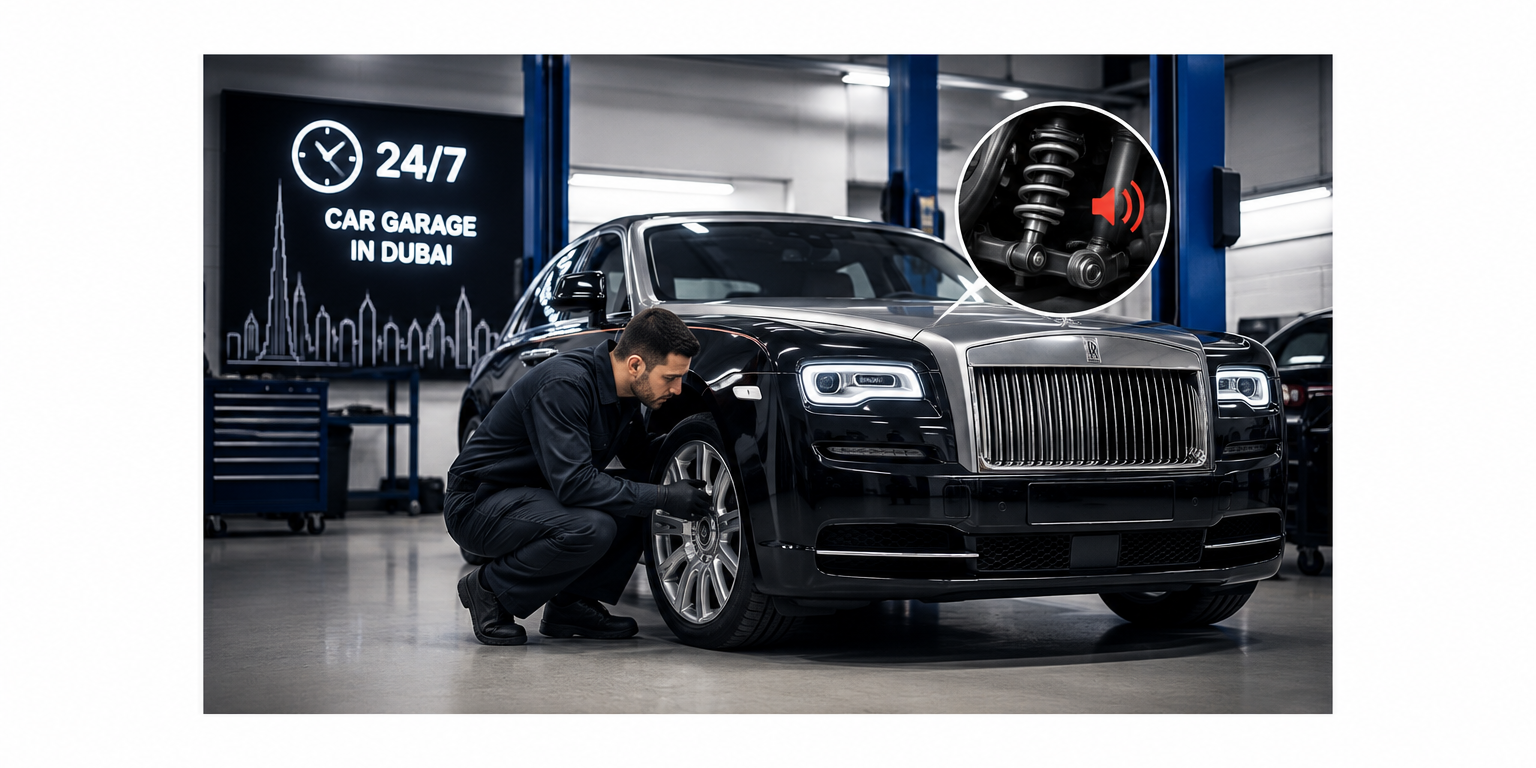
A Rolls-Royce isn’t supposed to make noise. That’s kind of the whole point of owning one.
So when you’re gliding down Sheikh Zayed Road and you suddenly hear it, a clunk over a speed bump, a creak turning into your driveway, a soft hiss near the wheel arch when you start the car in the morning, you notice it immediately. You’d notice it in any car, honestly, but in a Rolls-Royce it feels almost personal. This is the car that’s meant to float over everything. So when it doesn’t, something’s telling you it needs a look.
I’ve been working on these cars for years, mostly Ghosts, Phantoms, Wraiths, and a growing number of Cullinans, and I get some version of this question almost every week. So let’s go through what’s actually causing that noise, based on what I see on the lift, not just what a manual says should happen.
Why Suspension Noise Means More on a Rolls-Royce Than on Other Cars
Here’s the thing most owners don’t realize until they’ve lived with one for a while. Rolls-Royce doesn’t use a normal spring and shock setup. It’s an air suspension system, tied into self leveling sensors and, on the newer cars, that Flagbearer camera technology that reads the road ahead and adjusts the ride before you even feel the bump coming.
That’s a lot of moving parts working in silence, on purpose. So when something in there starts making noise, even a small noise, it stands out. In a cheaper car, a slightly worn bush might just blend into the background hum of the ride. In a Rolls-Royce, there is no background hum to hide behind. That’s actually a good thing for you as the owner. It means the car is telling you early, before a small issue becomes an expensive one.
What’s Actually Causing the Noise? Here’s What I See Most
The Air Compressor Getting Tired
The compressor is what keeps the air struts pressurized so the car can level itself and hold that signature smooth ride. In our climate, it just works harder than it would in, say, London or Munich. The heat wears down the internal seals faster, and after a few years you start to hear it. A soft whine or hum from underneath, usually right when you start the car or after it’s been parked a while.
I see this most on Ghosts around the five to seven year mark, especially ones that live outdoors during summer rather than in a shaded or covered space. It’s not dramatic, but it’s noticeable once you know what to listen for.
One thing I’ve picked up over the years, and it’s not something you’ll find in a service manual, is that cars used mostly for short hotel and valet runs in Downtown or on the Palm tend to show this wear earlier than cars driven longer distances on the highway. Constant short trips mean the compressor cycles on and off far more often, and it barely gets a chance to cool down between cycles in summer. A car doing regular airport runs on Sheikh Zayed Road usually holds up better than one doing five minute hops between valet stands.
Bushings That Have Simply Given Up
Bushings are the rubber and metal joints that connect suspension parts to the chassis. Their whole job is to stop metal from touching metal and to soak up small vibrations. When they dry out and crack, and Dubai heat speeds that process up considerably, you get a knock or a clunk, usually over speed bumps or those rough patches near new construction sites.
Honestly, this is probably the single most common thing I diagnose. Our roads are a strange mix of glass smooth highway and rough, uneven transitions near developments, and that constant back and forth is hard on these small components.
We had a Wraith come in a while back where the owner swore the noise only happened near his house. Turned out he lived in a newer community where the internal roads hadn’t fully settled yet, lots of shallow dips and patched sections from ongoing construction nearby. The front lower control arm bushings had worn unevenly because of it. Once we replaced them, the noise was gone, but I made a point of telling him it might come back sooner than usual if the road surface around his villa doesn’t improve. That’s the kind of context you only pick up from actually seeing where these cars live day to day.
Sway Bar Links Working Loose
These links control body roll when you take a corner. A worn one usually makes itself known as a rattle or clunk at low speed, pulling into a parking structure, easing into a driveway, that kind of thing.
I remember a Ghost owner who almost skipped this fix entirely because the rattle was so faint he could barely hear it with the windows up and the AC running. He only noticed it because his valet mentioned it while parking the car. That’s actually pretty common with sway bar links early on. The noise is subtle enough that owners driving with music or the AC on high miss it for weeks, while anyone standing outside the car catches it right away. If a valet, a parking attendant, or even a passenger mentions a rattle you haven’t noticed yourself, it’s worth taking seriously rather than dismissing it.
Sand. Just, Sand.
This one catches a lot of owners off guard, especially if the car came from Europe or the US originally. Fine desert sand gets into joints, ball joints, even the seals on the air struts. It acts almost like sandpaper over time, wearing things down faster than they’d wear in a cleaner environment. If your car sees regular desert drives, or even just a lot of city driving during dusty weather, this is worth checking specifically, not just assuming it’s a standard wear issue.
We had a Phantom owner once who was convinced his suspension had a fault straight from the factory, since the noise started only a few months after he bought the car. Turned out he’d taken it out to Al Qudra a couple of times for photos, driving slowly along the gravel tracks near the edge of the desert. Sand had worked its way into a front strut seal during those trips. It wasn’t a manufacturing issue at all, just an unexpected side effect of where the car had been. We cleaned and resealed it, and it’s been fine since.
A Leak in the Air Strut Itself
If one corner of the car is sitting visibly lower than the others, or you catch a hissing sound near a wheel, there’s a decent chance you’ve got an air leak. I see this more often on older Phantoms and early Ghosts, where the rubber air bladders have simply had more years to break down.
Wheel Bearings Pretending to Be a Suspension Problem
Sometimes what sounds like the suspension is actually a wheel bearing starting to go. It usually shows up as a low hum that gets louder with speed and shifts slightly when you turn the wheel left or right. It’s an easy mix up, honestly, and it’s exactly why guessing isn’t a great strategy here. A proper check settles it in minutes.
What’s Causing the Clunking Noise Over Bumps?
That clunk you hear over speed bumps is most often a worn control arm bushing, a failing sway bar link, or occasionally a bolt that’s worked itself loose. Basically, rubber that used to cushion the movement has dried out, so now you’re hearing small amounts of metal meeting metal.
How Do I Know if It’s the Air Suspension or Something Else?
If the car is sitting unevenly, taking longer to rise when you start it, or hissing near a wheel arch, it’s very likely the air suspension. If the noise only shows up over bumps and the ride height looks completely normal, you’re more likely looking at a bushing or a link.
A Story From the Garage
Not long ago a client brought in his Cullinan, pretty worried about a rhythmic knocking every time he went over the speed bumps near his community gate. He was already bracing for bad news, assuming it was the air struts and a big bill. Turned out to be one worn front sway bar link. A fairly small, affordable fix. The noise disappeared completely, and he actually messaged me a few days later saying the highway ride felt tighter too, which made sense once we’d replaced it.
I bring this up because suspension noise doesn’t automatically mean an expensive repair. It means something needs a proper look. Often the fix is smaller than people expect, but only if it’s diagnosed correctly the first time around.
Why a Regular Garage Usually Isn’t the Right Move Here
Rolls-Royce suspension systems aren’t something most workshops deal with day to day. The control unit, the sensors, the whole calibration process after any repair, all of it needs specific diagnostic tools and real familiarity with the BMW derived platform Rolls-Royce is built on.
Get the diagnosis wrong and you end up replacing parts that were never the problem, or worse, the ride height sensors don’t get recalibrated properly and the car still sits unevenly even after you’ve paid for the repair. That’s not a knock on general mechanics. It’s just a different skill set.
This is really where a place like Car Garage Auto Services comes in. We work on Rolls-Royce, Bentley, and other luxury cars daily here in Dubai, so we know the air suspension setup across Ghost, Wraith, Phantom, and Cullinan reasonably well at this point. We pull fault codes directly from the suspension control module rather than guessing, so you’re only paying to fix what’s actually wrong with your car.
A Few Things You Can Check Before You Even Book a Visit
You don’t need to be a mechanic to gather useful clues. A little observation before your appointment genuinely speeds up the diagnosis.
- Notice when the noise happens. Over bumps, mid turn, right after starting the car
- Look at whether the car sits level, or if one corner looks lower than the rest
- Pay attention to whether the noise changes with speed or stays constant
- Peek under the car near the wheel arches for any oily residue, which can point to a leaking strut
- Grab a quick video on your phone if you can. Sound context really does help narrow things down faster
What Does This Usually Cost in Dubai?
It depends entirely on what’s actually wrong. A worn sway bar link or bushing replacement tends to be fairly affordable. A full air strut replacement or compressor rebuild costs more, mainly because of the specialized parts involved. We always walk owners through the options and pricing before touching anything, because with a car like this, trust matters more than trying to sell you extra work.
How Do I Stop This From Happening Again?
Get the car inspected roughly every 10,000 to 15,000 kilometers, avoid leaving it parked outdoors in direct summer sun whenever you can, and don’t ignore small noises hoping they’ll go away. Catching a worn bushing early is a lot cheaper than replacing an entire strut down the line.
Final Thoughts
Suspension noise in a Rolls-Royce is never something to brush off, but it’s also not automatically a five figure disaster either. Most of the causes I’ve walked through here, worn bushings, a tired sway bar link, some wear in the air suspension, are well understood problems, especially in a city like Dubai where the heat and the sand speed everything up a little. The real key is getting an honest, accurate diagnosis from someone who actually knows these systems, rather than throwing parts at the car and hoping.
If your Rolls-Royce has started making noise, over bumps, mid turn, or just sitting there idling, it’s worth having it looked at properly. The team at Car Garage Auto Services can pinpoint exactly what’s going on and talk you through your options honestly, so the car gets back to that silent, smooth ride it was built for in the first place.
Frequently Asked Questions
Why does my Rolls-Royce hiss when I start it? A hissing sound near a wheel arch usually points to an air leak in the suspension strut, or a valve releasing pressure while the system levels itself. Worth getting checked before it gets worse.
Is it normal for my Rolls-Royce to sit lower on one side? No, it isn’t. An uneven ride height usually means an air suspension leak or a failing strut on that corner, and it should be looked at soon to avoid uneven tire wear down the line.
Can I keep driving if the suspension is making noise? For short trips, usually yes. But I wouldn’t put off a proper inspection for long. Driving on a worn component tends to speed up wear on whatever’s nearby too.
How long does a typical suspension repair take? Something simple, like a bushing or sway bar link, can often be sorted in a day. A full air strut replacement takes longer, mostly depending on parts availability.
Does Dubai’s climate really make that much of a difference? Yes, genuinely. The heat breaks down rubber seals and bushings faster, and fine sand works its way into joints and seals over time. Both speed up wear compared to a cooler, cleaner climate.